
President-elect (or should we say, President-elected-again) Donald Trump is not known for being much of a reader. So it is doubtful he is preparing for his second term by reading biographies of his presidential predecessors. But as he embarks, there is a useful teaching instrument available to him in movie form: Reagan, the biopic starring Dennis Quaid. Watching it could be a good use of Trump’s time.
The movie, released two months before the election, chronicles the life of our 40th President, from his hardscrabble origins in a small town with an alcoholic father, to the White House. It received the kind of reception that ought to appeal to the new President. Critics loathed it. According to Rotten Tomatoes, it earned a paltry 18% score among them. But ordinary Joes and Janes loved it. Rotten Tomatoes recorded an astronomical 98% rating among regular moviegoers.
The movie is not Academy Award material, as even some honest fans of the Gipper have admitted. It is hagiography, in the tradition of Parson Weem’s Life of Washington. (If Ronald Reagan ever confessed to chopping down a cherry tree, the movie would have shown it.) And a very wide chasm separates the respective ideologies, temperaments, and dispositions of Reagan and Trump.
Nevertheless, Reagan offers valuable lessons for the incoming administration, if Trump is willing to watch – and learn. Here are a few of those lessons.
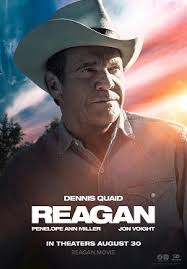
First, develop a consistent message, one that the entire executive branch can understand and support. The movie shows Reagan articulating a consistent theme, from his days as a spokesman for General Electric, to the California statehouse, to the White House. His message was: reduce the size of government at home, rebuild American military power abroad.
Developing a consistent theme for the newly elected President may prove difficult. Trump leads a coalition of separate, often mutually hostile, factions. For example, Trump favors fracking and drilling. But his HHS Secretary-designee Robert F. Kennedy, Jr., is an ardent environmentalist who has called for the elimination of subsidies for fossil fuel. On election night, Trump tried to make a joke of their differences, promising that “Bobby” would be allowed to weigh in on health issues, but as to energy: “Leave the oil to me…. Other than that, go have a good time, Bobby.”
He has chosen Marco Rubio for Secretary of State, where he is expected to advocate for a strong, muscular U.S. presence abroad. But his Director of National Intelligence-designee is the neo-isolationist Tulsi Gabbard.
Turf wars in American government are natural, even healthy. The Secretary of State traditionally butts heads with the National Security Advisor. Both are careful to protect their domains from the Defense Department. The Departments of Labor and Commerce are natural enemies.
But battles over turf can be managed by a strong chief executive. Battles over ideology are a different matter – especially when the President is someone who is not particularly ideological. Reagan had a strong set of ideological positions, and he was willing and able to impose those positions on warring factions. Trump’s White House will be different. Unless he can develop a consistent theme, the post-election jubilation could quickly descend into chaos.
Second, learn to articulate that message clearly, in a way that the entire administration and the general public can understand. The movie shows Reagan explaining his Cold War strategy to a top aide: “We win. They lose.” That kind of terse clarity made it possible for his team up and down the command chain to implement his policy. They didn’t have to guess at what the boss wanted. They knew.
Again, this lesson may prove difficult for the President-elect to learn and apply. Trump is a notoriously undisciplined speaker. During his campaign, his speeches meandered endlessly. Sometimes, he seemed to argue with his teleprompter. Audiences could tell when he was going off-script because those were the times he appeared most engaged and passionate. Unless Trump can articulate and then stay on a message, his presidency will create a record as confused and disjointed as his campaign speeches.
Third, don’t hesitate to defy the experts. In Reagan, the President calls upon the scientific community to turn their talents away from creating nuclear weapons to developing technologies to shield the world from those weapons. This was the Strategic Defense Initiative (SDI), popularly known as Star Wars.
At the time, SDI was considered a joke among experts, who considered the whole idea “far-fetched.” Calling it “Star Wars” was not intended as a compliment.
The movie, however, shows that Reagan’s commitment to SDI ensured the Soviet Union’s defeat in the Cold War. The Soviets believed that SDI would work, and they knew that their faltering economy could not afford to match it.
Moreover, contrary to the experts’ ridicule, SDI ultimately did work. The United States and Israel jointly developed the technological capability to shoot down ballistic missiles, a capability sometimes compared to hitting a bullet with a bullet. SDI was the progenitor of Israel’s Iron Dome, Arrow, and David’s Sling missile defense systems. Moshe Patel, Director of the Israel Missile Defense Organization, recently noted that Israel’s ability to shoot down nearly all of the Iranian ballistic missiles resulted from research initiated under Reagan’s SDI project.
It should not be difficult for the Trump administration to apply this lesson, and ignore experts. The risk here is that they may apply it too well. Designating Robert F. Kennedy, Jr. as HHS Secretary has generated grave concern among medical experts, because Kennedy is notorious for his suspicion (some would say “paranoia”) toward vaccines. Experts make mistakes, as we learned repeatedly in the Covid pandemic: closing beaches, restricting outdoor activities, locking down schools. The challenge for the new administration will be to balance a healthy skepticism toward experts without degenerating into a kind of anti-scientific Ludditism.
Finally, the movie teaches importance of cultivating relationships with the opposing party. It depicts Reagan’s adversarial but constructive relationship with Tip O’Neill, the Democratic Speaker of the House. The two Irishmen squared off against each other on tax and budget policy, but managed to forge a friendship after 6 pm. In one of the movie’s most touching scenes, O’Neill visits a wounded Reagan in the hospital after the attempted assassination. (O’Neill was in fact the first non-family member allowed in to see him.) After some gentle partisan kidding, the two men pray together, reciting the 23rd Psalm.
It is hard to imagine Donald Trump praying with Hakeem Jeffries or Chuck Schumer. And the incoming Trump administration may consider such conciliation unnecessary. After all, their Party, unlike Reagan’s, has majorities in both chambers.
But that would be a mistake. The current Republican majority in the House is not only fractious, it is razor-thin. A couple of deaths or retirements could switch control to the Democrats. The Republican control of the Senate is more secure, but it may not last. In 2026, Republicans will be defending nearly two thirds of the seats up for election. And off-year elections usually favor the party out of the White House.
Donald Trump fancies himself the archetypal deal-maker. He would do well to watch Reagan, and then to figure out ways to do business with his Democratic opponents in Congress.
Will Trump watch Reagan? If he does, will he understand and apply any of its lessons?
If he doesn’t, expect more of the kind of turmoil the nation experienced in his first term in office. If he does watch and learn, the road ahead may be, if not smooth, then at least a little smoother.
Either way, to paraphrase a classic but very different film: “Fasten your seatbelts. It’s going to be a bumpy four years.”

 toputitbluntly.com