The nation’s attention is currently focused on two killings that occurred blocks apart in the same city. The different national reactions to these two New York events may seem to reflect the political fault lines in our country. But they expose something deeper than politics. They expose different societal attitudes toward the enduring conflict between order and chaos.
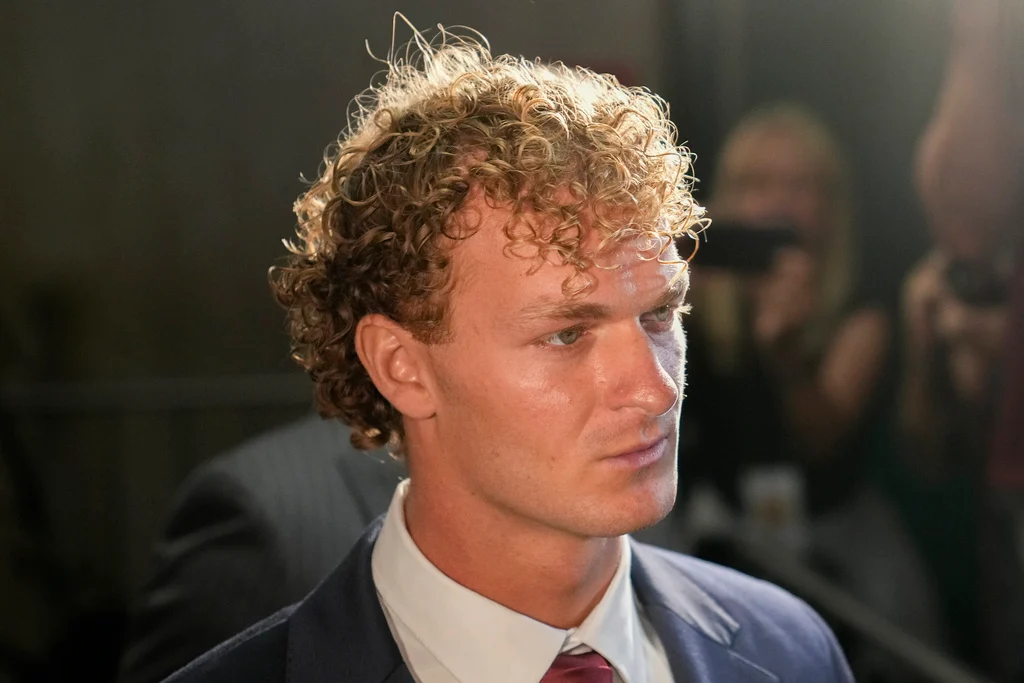
The first killing occurred on May 1, 2023, on an F-train near the Broadway-Lafayette subway station. Daniel Penny, an ex-Marine, grabbed Jordan Neely in a chokehold from behind, and held him for six minutes. Neely a homeless man with a record of 42 prior arrests, including 4 for alleged assault, had been threatening passengers, announcing “someone’s going to die today” and telling them that he did not care if he was the one. At the time of his death, there was an outstanding warrant for his arrest, arising from his assault on a 67-year old woman on a subway car. In that incident, the victim sustained a broken nose, a fractured orbital bone, and bruising and swelling of the back of her head.
The second killing occurred on December 4, 2024, at the Midtown Manhattan Hilton Hotel, about an hour’s walk from the first incident. Brian Thompson, the CEO of United Healthcare, was on his way to an investor conference when he was fatally shot by a masked assailant. The as yet unidentified killer fled the scene on a bicycle, and is now believed to have left the City.
Penny is currently on trial for the death of Neely. The death of Thompson is under investigation.
At first glance, the public reactions to the killings seem to fit a pattern, with observers lining up along familiar political borders.
In 2023, when news broke of the subway killing, many on the progressive Left reacted, almost reflexively, with sympathy and support for Jordan Neely (who was black) and hostility toward Daniel Penny (who is white). They pressured Alvin Bragg, the Manhattan district attorney, to bring criminal charges. Merely waiting to investigate, rather than filing charges immediately, was deemed “racist.”
During the trial, members of Black Lives Matter and the National Action Network protested nearly every morning across from the courthouse. When Penny arrived, they called out “murderer” and “subway strangler.” Their chants could be heard in the 13th floor courthouse where the trial is taking place.
Left-wing pundits did all they could to paint Penny as a racist –a challenging task since there was no actual evidence to support the charge. Zeeshan Aleem, an MSNBC opinion writer/editor, with more imagination than common sense, seized upon Penny’s statement in an interview that “[he] was actually planning a road trip through Africa before this happened” as somehow demonstrating his racism.
…[T] here is nothing about planning a trip somewhere in Africa that would exonerate him from a charge of racial prejudice. There is, in fact, a long and dark history of racist white people visiting Africa, as Penny ought to know.
On the other side of the political spectrum, conservative politicians and commentators embraced Penny as a hero. The incident occurred during the Republican presidential primary season. Candidates immediately vied with each other to see who could support Penny more. Nikki Haley called on New York Governor Kathy Hochul to pardon him. Ron DeSantis wrote that it’s imperative to “take back the streets for law abiding citizens” and called for support to show him that “America’s got his back.” Vivek Ramaswamy sent $10,000 to a fundraiser for his legal defense, which quickly raised over $2.5 million.
After the election, Republican Congressman Eli Crane of Arizona introduced a resolution to award Penny a Congressional Gold Medal.
The reaction following the murder of Brian Thompson also seems to align with recognizable political borders, albeit in reverse.
This time, commentators on the Left have expressed sympathy, if not support, for the killer, while those on the Right have expressed moral outrage.
Former Washington Post reporter Taylor Lorenz wrote several social media posts critical of the insurance industry, then concluded: “And people wonder why we want these executives dead.” Writing in the liberal British publication The Guardian, a commentator went so far as to criticize those upset over Thompson’s death for their supposed failure to show sufficient sympathy to the Palestinians:
It’s quite illuminating to see who is vocally outraged by Thompson’s death yet indifferent to murder on an industrial scale. Representative Ritchie Torres, for example, has tweeted that Thompson’s assassination “is so shocking that it leaves one speechless”. Meanwhile, Torres is working overtime to whitewash the mass murder of Palestinians in Gaza – which Amnesty International has labelled a genocide. Violence is apparently not shocking when it’s against people you consider subhuman rather than wealthy white CEOs.
Meanwhile, the editors of the conservative National Review have weighed in with outrage over the Left’s lack of outrage. Michael Brendan Dougherty called the Left’s reaction “an ugly thing.” Dominic Pino labeled it “repulsive.” Charles C.W. Cooke commented on the Left’s effort to explain away the killer’s motives:
It feels grotesque to me to even enter into discussions of the detail. What happened here was a man, a human being, was murdered in cold blood on the street. Once you get to why, you’re starting to negotiate with it. And I don’t want to negotiate with that.
In this tale of two killings, do the differing public reactions depend upon where one stands in the political spectrum?
Not really. For one thing, the lack of moral outrage over the Thompson shooting, which so outraged the editors of the National Review, is not limited the Left. Plenty of people on the Right also resent insurance companies, and have shed no tears for Thompson. We know this by the sheer number of social media reactions. For example, a Facebook post by UnitedHealth Group expressing sadness about Thompson’s death received 62,000 reactions – 57,000 of them laughing emojis.
No one has introduced a resolution in the House to give Thompson’s killer a Congressional Gold Medal, but thousands of TikTok users have posted comments honoring him. Typical posts include: “Praying for his speedy escape and long healthy life”; “My thoughts and prayers go out to him and his family, I hope he manages to successfully evade the police and gets home safe.” A folk song glorifying the killer garnered hundreds of thousands of views and laudatory comments on social media before it was taken down.
Based on the numbers alone, it is safe to assume that many of those who have shown a lack of remorse for the murder are MAGA members.
If conventional political divisions do not explain the differing reactions to the two killings, what does?
The answer lies in the conflict between order and chaos, a conflict that transcends politics. In this enduring duality, there are rabble-rousers and there are guardians of social order, and they inhabit all sides of the political spectrum. Their fundamental difference is not about politics. It is about civilization. One side strives to uphold it. The other seeks to undermine and eventually destory it.
In the subway incident, when Daniel Penny arose from his seat in a car full of terrified passengers, he was standing up for order. Those passengers saw him trying to supply something the City of New York transit system could not or would not provide: a sense of civilization in an increasingly chaotic and dangerous place, a domain where the murder rate has risen 60%.
The murder of Brian Thompson — though it occurred in the heart of Manhattan’s business district in front of a posh hotel — was another glimpse into a world in chaos, as sinister as any dank subway tunnel.
Daniel Penny faces the risk of conviction for criminal negligence. (The Judge in the case has dismissed the more serious charge of manslaughter.) But even if he is convicted, that will not change the fact that he represented order. It is in the nature of order to sometimes drift over the line of proportionality and into the zone of excess. Its goal remains wedded to preserving civilization, even if it does so imperfectly.
Brian Thompson’s murderer appears to be a careful, meticulous planner, a man completely different from the raving, drug-using Jordan Neely. But the differences are superficial. Thompson’s murderer is no less a symbol of chaos than Neely was. Right now, his identity, background, and motives remain unknown. But even if it turns out (as some have speculated) that he is a disgruntled, otherwise law-abiding citizen, who turned to crime only because of an unjust determination by an insurance company, he still represents chaos. He represents a world in which violence, not a legal process, decides disputes.

It remains to be seen whether Daniel Penny will be convicted. It remains to be seen whether Brian Thompson’s murderer will be found and brought to justice. And it remains to be seen, in 21st century America, which side will gain the upper-hand in the timeless struggle between order and chaos.
[Note: Twelve hours after this post was published, the jury in the Daniel Penny case acquitted him of the one remaining count of criminal negligence.]
 toputitbluntly.com
“Based on the numbers alone, it is safe to assume that many of those who have shown a lack of remorse for the murder are MAGA members” you say.
Larry, are you kidding me?? You may as well have said,
“Based on the numbers alone, it is safe to assume that many of those who have shown a lack of remorse for the murder are Jewish.”
(Or substitute almost any group identifier as the last word.)