
Whether you are a lawyer or just interested in the law, chances are you have heard of Humphrey’s Executor. It seems that the case is always mentioned whenever pundits debate President Trump’s power to fire members of federal agencies.
Supporters of Rebecca Kelly Slaughter, formerly a member of the Federal Trade Commission, cite the Humphrey’s Executor decision to contest Trump’s right to terminate her. In that 1935 case, the Supreme Court ruled 9-0 that an FTC commissioner can be fired only “for cause,” which under the FTC Act is defined as “inefficiency, neglect of duty, or malfeasance.” Disagreement over policy, according to the Court’s holding, is not a sufficient basis for termination.
Trump’s supporters contend that the FTC, like all federal agencies, is part of the executive branch of the federal government. All members of that agency must be answerable to the President since he is the head of the executive branch. Otherwise, the federal agencies would constitute an unconstitutional fourth branch of government. They urge the Supreme Court to overrule Humphrey’s Executor.
But just who was this fellow Humphrey?
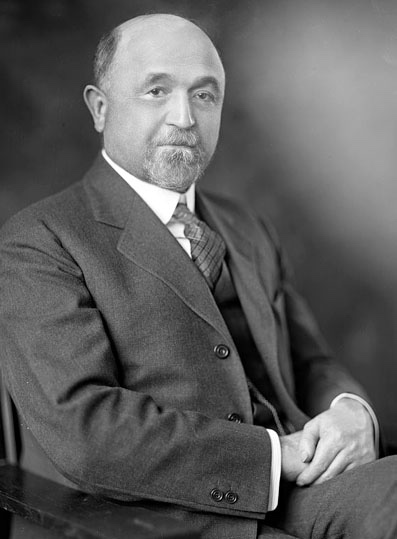
Answering this question entails delving into the life of one of the more interesting curmudgeons in our nation’s history. It also illustrates how political partisans, who celebrate a judicial holding one day, often switch sides and condemn it the next when the political tides change. Likewise for those who condemn a holding, but later decide that they actually admire it.
William Ewart Humphrey, like Rebecca Kelly Slaughter, was an FTC commissioner, but beyond that, the pair had little in common. Humphrey was born about 120 years earlier, and came from a very different background than his Yale-educated successor.
Humphrey grew up in the tiny town of Alamo, Indiana. (The most recent U.S. Census lists the population as 67.) He graduated Wabash College, 13 miles away, in 1887. Law school was not a prerequisite for bar membership in those days. Humphrey gained admission to the bar right after he graduated college, and he opened a modest practice nearby. The Panic of 1893 devastated the local economy, so Humphrey moved to greener pastures in Seattle, Washington. It was his first time away from Indiana, and the move led to new prosperity and opportunities.
Humphrey’s law practice flourished in Seattle. He became a prominent member of the local bar, and served as Corporation Counsel for the City of Seattle. In 1902 he ran for Congress on the Republican ticket, and won. At the time, the State of Washington’s three congressional representatives served at large. In 1909, the State was divided into three separate districts. Humphrey represented the First Congressional District, covering northwest Seattle.
According to Library of Congress and House Archive records, Humphrey’s 14 years in the House of Representatives were undramatic, producing no widely-cited federal statutes credited to him. Perhaps his most substantive action was derailing a bill introduced by fellow Washington State Representative Francis Cushman for the protection of elk and game on the Olympic Peninsula. Humphrey introduced a rival bill more favorable to the timber industry. The dispute was rendered moot when President Theodore Roosevelt created the Mount Olympus National Monument.
If Humphrey left any lasting mark from his congressional service, it was his penchant for raising points of order on appropriation and legislative procedure.
In 1916, he ran for the U.S. Senate. He lost, thus ending his political career. But it did not end his civic career. In 1925, President Coolidge appointed him to a 7-year term on the Federal Trade Commission, an appointment extended to a second term by President Hoover.
Humphrey had strong views about the role of the Commission. He proclaimed that he would not approve any Commission action that was not designed to “help business help itself.” He condemned the FTC for taking any coercive action, and considered its litigation “an instrument of oppression and disturbance.”
He was not one for collegiality. He threatened fellow commissioners with whom he disagreed with criminal prosecution. When the FTC voted to investigate possible ties among DuPont, U.S. Steel, and General Motors, Humphrey lambasted his colleagues as men “drunk with their own greatness.”
In reaction to Humphrey’s conduct, some Congressmen introduced legislation to abolish the FTC altogether. But the newly elected President Franklin Roosevelt decided it would be simpler to remove the troublesome commissioner rather than scrap the whole Commission. Word got around of the President’s intention, leading Humphrey to send out a pre-emptive letter. “My dear Mr. President,” it began, “Information comes to me that you are going to ask for my resignation. For what reason I do not know.” Humphrey noted that after decades of public service, resignation would “greatly injure” his professional life.
A few days later, Roosevelt responded politely but negatively, writing that he found “it necessary to ask for your resignation.” He explained that he believed that the FTC’s work could “be carried out most effectively with personnel of my own selection.” He concluded by commending Humphrey for his “long and active service.”
Humphrey immediately replied that he was “somewhat disturbed and shocked” by the President’s letter. He complained that he had “lost all professional and business connections after being out of practice for nine years.” He refused to quit.
Ignoring Humphrey’s position on the matter, Roosevelt sent him a telegram three days later “accepting [his] resignation.”
Humphrey, the past master of parliamentary points of order, refused to resign. He argued that the President’s request that he resign “for purely political reasons” violated the Act, which provided that commissioners could be removed only for “inefficiency, neglect of duty or malfeasance in office.” He complained that if he resigned, he would “stand convicted in the public mind” of such bad behavior.
Humphrey, in short, would stay put.
Roosevelt gave it one more try. “You will, I know, realize that I do not feel that your mind and my mind go along together on either the policies or the administering of the Federal Trade Commission, and, frankly, I think it is best for the people of this country that I should have a full confidence,” he wrote on August 31, 1933.
After waiting in vain for a response, Roosevelt fired Humphrey on October 7.
Humphrey was not the sort of man to take a firing sitting down. He continued to show up for work, telling his fellow commissioners that he remained a member of the FTC. He wrote to George C. Matthews, the man Roosevelt had named as his successor, informing him that “there was no vacancy” on the Commission.
Having drawn his principled line in the sand, Humphrey’s next move was to die of a hemorrhagic stroke 5 months later, on Valentine’s Day.
That might have ended the matter, but for the action of Samuel Rathbun, the executor of Humphrey’s estate. He sued the government in the federal Court of Claims for the decedent’s salary for the 5 months he had dutifully continued to show up for work after his purported firing. The lawsuit was not merely symbolic. During the Depression, FTC commissioners were paid $10,000 annually, about $243,000 in current dollars. The claim would be worth about $101,250 today.
The issue went up to the Supreme Court. William J. “Wild Bill” Donovan, the future head of the OSS, the forerunner of the CIA, argued for Humphrey’s Executor. Solicitor General and future Supreme Court Justice Stanley Reed argued for the government. On May 27, 1935, the Court ruled unanimously in Humphrey’s favor.
At the time, the Supreme Court was viewed by progressives as a reactionary bastion. On the same day the Court invalidated Roosevelt’s attempt to fire Humphrey, it also issued unanimous decisions in Schechter Poultry Corp. v. United States, declaring that the National Industrial Recovery Act was unconstitutional, and in Louisville Joint Stock Land Bank v. Redford, striking down the Frazier-Lemley Farm Bankuptcy Act, which was designed to assist farmers facing foreclosure. These three setbacks for the New Deal administration became known as “Black Monday,” and led Roosevelt to embark on his unsuccessful plan to pack the Court.
Were they alive today, William Humphrey might be deemed by progressives as a champion of freedom, defending the independence of federal agencies; and Franklin Roosevelt might be seen as a Trumpian dictator, attempting to remove independent experts from the government and to replace them with hand-picked cronies.
The Supreme Court might be viewed by progressives as a bulwark for liberty, guarding the federal government from authoritarian domination.
Conversely, MAGA Republicans might applaud Roosevelt for his effort to remove the remnants of the “Deep State” bureaucracy, and to ensure the government reflected the views of the democratically elected President. They might lambaste the 1935 Supreme Court for its activist intervention.
The life — and, equally important, the death — of William Ewart Humphrey teach us that politics and judicial interpretation may march together in our national history, but they do not march in lock-step.
 toputitbluntly.com
informative and fun