
Barbie and Oppenheimer are unlikely cinematic twins. Released on the same day, they both achieved immediate, immense success. Barbie generated $1 billion in ticket sales in 17 days, the fastest time any Warner Bros. film has reached that landmark. Oppenheimer crossed the half billion dollar mark in the same time span, making it the highest grossest World War II movie in history.
Barbie is a playful fantasy about a Barbie doll whose arched feet suddenly flatten. She must venture out of Barbie World to the real world, to find the human owner responsible for this and other “malfunctions.” The film features colorful plastic backdrops, and rocking song and dance numbers performed by troops of Barbie and Ken dolls. There are occasional gravitas breaks for sermons on feminism, but the most part this is a movie that wants its audiences to relax and have a good time.
Oppenheimer is a 3-hour biopic about the creation of the atomic bomb. Like the critically acclaimed biography American Prometheus, upon which the movie is based, Oppenheimer takes a generally sympathetic view of its subject, portraying him as a brilliant and patriotic scientist, unfairly caught up in the Cold War hysteria following the end of the war. Whatever its editorial bias, the movie is a thoughtful work of history, accurately depicting the scientific and engineering challenges faced by Oppenheimer’s team, and even offering extensive expositions on nuclear physics.
Unlike Barbie, Oppenheimer has no songs, no dance numbers, and not a single joke. This is a movie that wants its audiences to take it seriously.
With their cosmic content differences, one might expect the movies to appeal to vastly different audiences. Surprisingly, there has been much overlap in viewership. On opening weekend, 200,000 viewers paid for tickets to see both. Culturally, “Barbenheimer” has become a meme, with t-shirts showing Barbie and Oppenheimer together watching a pink mushroom cloud rising over the desert.

To the extent their audiences differ, they do so in unexpected ways. Since Barbie offers girl-power speeches on feminism, and Oppenheimer celebrates American military and industrial power, one might expect Barbie to thrill progressive moviegoers, while Oppenheimer excites the patriots. But according to a Fox News survey, the opposite holds. Its electoral map shows Barbie trending in red states while Oppenheimer has the edge in blue states.
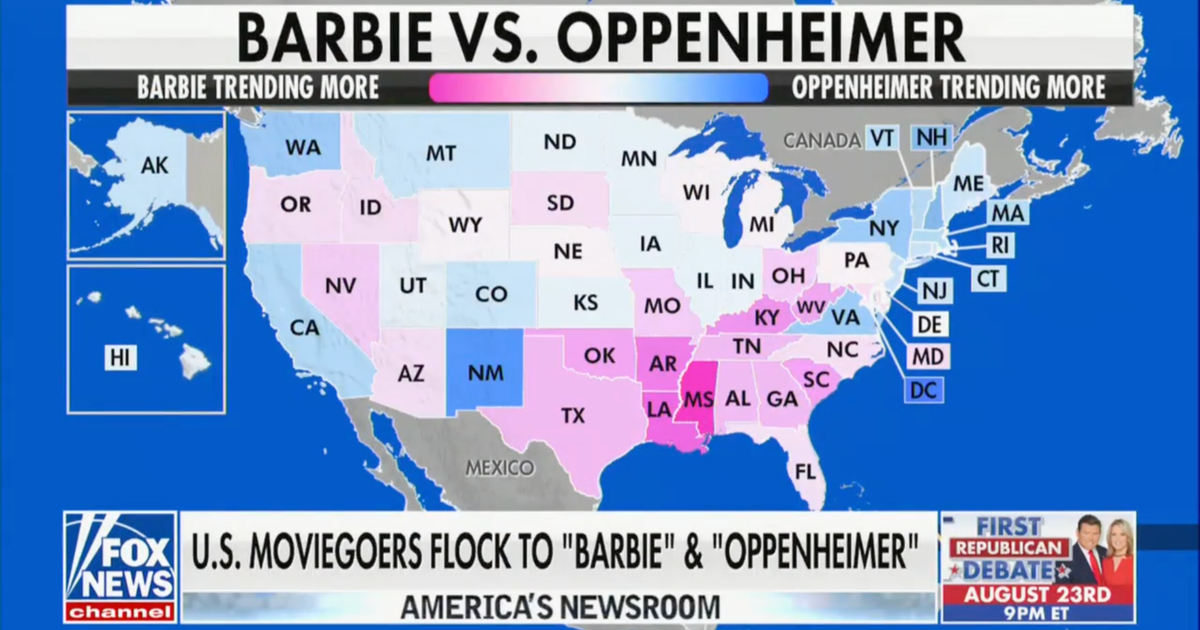
The same week the two movies were released, a House Oversight Committee held hearings on unidentified anomalous phenomena – commonly known as UFOs. The timing was fortuitous. If aliens have been visiting this planet lately, they might be mystified by members of the same terrestrial species finding entertainment in both productions.
How would we explain this phenomenon to them?
Well, we might explain that Barbie and Oppenheimer, despite their many differences, both contain positive themes that are particularly appropriate for our Post-Covid Era.
Before getting to these positive messages, let’s concede the obvious. This may not be what the writers and producers intended. On the contrary, they likely considered their works freighted with somber themes.
For example, when Barbie visits the real world, she experiences men ogling her and she feels fear for the first time. When she visits the Mattel boardroom, she sees only men. This self-deprecation is certainly one of the strangest aspects of Mattel’s involvement in the movie. In fact, 5 of Mattel’s 11 Board members are women. For its first 30 years, the Company’s President was a woman – who also happened to be Barbie’s inventor. In Barbie World, Barbies occupy the White House and all nine seats on the Supreme Court. The real world is supposed to be the evil mirror image of Barbie World, apparently where women are as powerless as the Kens in Barbie World.
Likewise, in Oppenheimer, the subject must deal with critics who doubt his loyalty. Their suspicions were not completely unjustified. The movie mentions Klaus Fuchs, who later confessed to being a Soviet spy. But he was just one of many Manhattan Project scientists who spied for the Soviet Union. He must also deal with his conscience. In a congratulatory speech to his team following the successful use of the atomic bomb, Oppenheimer imagines an incinerated Japanese corpse at his feet. After the war, when invited to the White House to meet President Truman (played by Gary Oldman in one of many marvelous cameos in the movie), Oppenheimer confesses that he feels that he has blood on his hands. Unimpressed, the President hands him a handkerchief and calls him a “crybaby.”
But whatever dark profundity the writers and producers intended, their movies attract crowds because they convey uplifting messages attuned to the times.
Barbie may discover rampant sexism in the real world, but Barbie is a doll. She is make-believe. The “real” female character in Barbie is not Barbie but Gloria, beautifully played by America Ferrera.
Gloria describes herself as “just a boring mom with a boring job and a daughter who hates me.” But by the movie’s end, she emerges as the true heroine. And her daughter comes to appreciate and love her. We even get brief glimpses of her husband (portrayed by Ryan Piers Williams, Ferrera’s real-life husband), trying to learn Spanish. He speaks the language poorly but the message is clear. To the best of his ordinary abilities, this man is supporting his ordinary wife in the best way he can.
Moms who dress up in pink to attend the show may enjoy pretending to be Barbie. But if they bring their daughters or husbands along, it is Gloria they hope to emulate.
Similarly, Oppenheimer may depict its protagonist encountering pangs of conscience, but the movie is about more than one man. It is about a nation at war mustering its resources to turn theoretical physics into an awesome reality. The development and use of the atomic bomb are controversial subjects, but whatever one might believe of their morality, there is no question that the Manhattan Project represented an achievement of titanic proportions. Sometimes the government works.
The biggest casualty of the Covid pandemic was public trust in our government, which appeared in turn petulant, indecisive, intolerant, and ineffective. That is not the government portrayed in Oppenheimer. There is little doubt that audiences, if given the choice, would prefer Matt Damon’s General Leslie Groves over Anthony Fauci to guide it through the pandemic. And even though he appears only briefly – and in a less than flattering light – they would almost certainly prefer Harry Truman to the pair of dunderheads likely to win their parties’ nominations and face each other in the 2024 presidential race.
That is why Barbie and Oppenheimer, in their own very different ways, and despite their writers’ probable intentions, are movies for the Post-Covid Era.
In the Barbenheimer universe, mothers and daughters, cooped up inside together for too many long months, are free to leave the house and live in the fresh air. Families can finally take off their N95 masks and rediscover why they love each other.
In the Barbenheimer universe, the government can set goals and accomplish them, even if those goals are beyond anything done or imagined before. In that universe, government scientists, soldiers, and politicians are not perfect. They never are in movies. But they are dedicated – and more importantly, they are competent.
After Covid, the country needed entertainment that made families feel good about themselves, and that made citizens feel confidence in their government. Barbie and Oppenheimer, unlikely twins, both fulfill that need.

