
In the aftermath of the attempted killing of Donald Trump, leaders from both sides of the political spectrum have urged Americans to “turn down the temperature.”
President Biden asserted that political rhetoric had become “over-heated” and urged all Americans to “cool it down.” On the same day, Republican House Speaker Mike Johnson complained that Biden’s attacks on Trump had contributed to a “heated political environment,” adding: “We’ve got to turn the temperature down in this country.”
It’s easy to see the appeal of pleas for reason over passion, especially in the wake of an assassination attempt. But let’s not go too far. Passion has a proper place in politics. And while some calls to turn down the temperature may be sincere, others may be cynical attempts to deflect legitimate criticism.
Consider the reaction to J.D. Vance’s selection as Trump’s running mate. Immediately after the selection was announced, the Biden campaign (which was obviously prepared for the announcement) posted on X:
Here’s the deal about J.D. Vance. He talks a big game about working people. But now, he and Trump want to raise taxes on middle-class families while pushing more tax cuts for the rich.
To which a Trump campaign official replied:
I think that response, given the events that have transpired in this country where President Trump had an assassination attempt on his life, for the sitting U.S. president to be calling for anything other than unity, but instead using this opportunity to attack President Trump’s new vice presidential nominee, go after him on policy, it seems really out of touch, really in poor taste.
Since when did going after a nominee “on policy” constitute poor taste? Isn’t that exactly what campaigns are supposed to do? Invoking the assassination attempt to shield a nominee from such attacks is not idealistic. It is opportunistic.
Another reason to exercise skepticism when hearing pleas to turn down the temperature is the possible lack of linkage between the rhetoric and the violence. As of now, there is no evidence that our “over-heated” political dialogue played any role in Thomas Matthew Crooks’s decision to climb atop a building and shoot a presidential candidate and three spectators.
Sometimes such linkage exists, and sometimes it does not.
In the case of James Hodgkinson, it did. He was the man who fired 70 shots from a pistol and rifle at Congressional Republicans and their staffers, as they practiced for the Congressional Baseball Game for Charity, wounding five including then House Majority Whip Steve Scalise, who was nearly killed. According to a Secret Service profile, Hodgkinson was a political activist who fervently backed Bernie Sanders’s presidential campaign, and who posted: “It’s time to destroy Trump & Co.”
But in other cases, linkage between rhetoric and violence does not exist.
On January 8, 2011, Jared Lee Loughner opened fire at a grocery store parking lot in Tuscon, Arizona, killing six people (including a federal judge and a nine-year old girl), and seriously wounding Congresswoman Gabby Giffords. An editorial in the New York Times later blamed Sarah Palin for the crime, claiming that a map circulated by her political action committee encouraged her followers to target Democratic incumbents, including Giffords, for execution.
It turned out that politics and Sarah Palin’s map played no role in the violence. Loughner was mentally deranged, and believed that the government controlled citizens’ minds by controlling their grammar. There was no evidence that Loughner had even seen the map.
So far, there is no evidence to support the supposition that politics moved Crooks to pull the trigger. (That may change as the FBI investigation continues.) What little we know about this would-be assassin is enigmatic and contradictory. We know that he was a registered Republican, but we also know that he gave a $15 donation to Progressive Turnout Project, a Democratic-aligned political action committee. We know his mother is a registered Democrat. We know that his father a registered Libertarian. There are also reports that he was bullied by his high school classmates.
It may turn out that Crooks, like Hodgkinson, was influenced by political rhetoric. But it is also possible that he was a confused and deranged individual like Loughner, moved by mental illness rather than by “over-heated” political dialogue.
Even if Crooks did see the many provocative and disturbing attacks on Trump (such as Biden’s July 8 remark that it was “time to put Trump in the bullseye” or the New Republic’s repulsive cover depicting Trump as Hitler), before we accede to requests to turn down the temperature, we should acknowledge the possible costs. Our nation was founded on the principle of freedom of speech, including speech that is robust, rowdy, and hot-tempered.
Look no farther than our Declaration of Independence. Thomas Jefferson condemned King George for being a “Tyrant” responsible for personally committing a wide range of “barbarous” conduct: “He has plundered our Seas, ravaged our Coasts, burnt our Towns, and destroyed the Lives of our People.” Thomas Paine described the King as “the Royal Brute of Britain,” a man with a “thirst for absolute power,” adding “Even brutes do not devour their young, nor savages make war upon their families.” Such heated ad hominem attacks, even when factually dubious, are part of our heritage.
And speaking of “over- heated” political rhetoric, the abolitionist William Lloyd Garrision demonstrated that the phrase was not just a metaphor when, on a sweltering July 4th, he burned a copy of the Constitution, calling it “a covenant with death, and an agreement with hell.” Garrison was alluding to the fact that the Constitution allowed slavery to persist. “More than the extreme heat of July,” a Boston newspaper noted, “he had excited the passion of the crowd.” Rather than condemn Garrison for enflaming his audience, today we honor him as a pioneer of the anti-slavery movement.
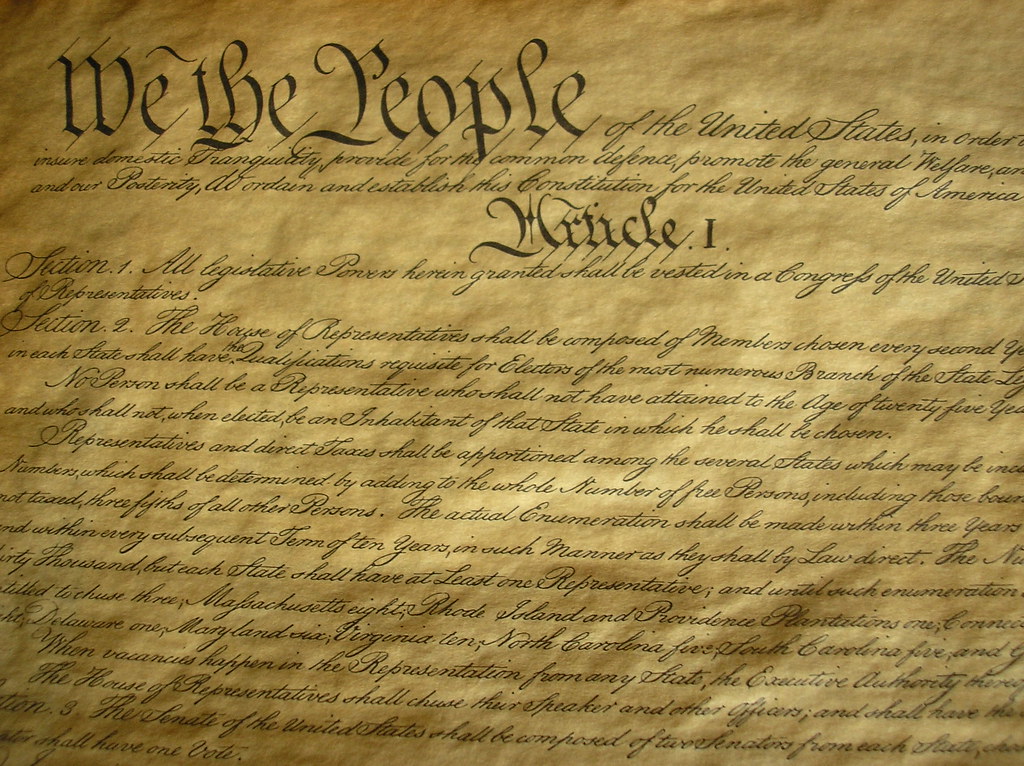
Whether seen in the text of the Declaration of Independence or in the burning of the Constitution, passionate speech is often the most effective way to articulate political positions, and to define differences with the opposition. Assuming they both remain on their parties’ tickets, Joe Biden and Donald Trump have a right to assail each other’s policies, and to do so zealously.
Finally, we should be careful about heeding pleas to turn down the temperature because such pleas may grant – albeit unintentionally – undeserved power to the violent actors. Whatever one might think of Bernie Sanders and his politics, Bernie Sanders did not shoot Steve Scalise. James Hodgkinson did. If it turns out that Thomas Matthews Crooks heard Joe Biden declare that it was “time to put Trump in the bullseye,” that will not change the fact that Joe Biden did not shoot Donald Trump and three spectators. Thomas Matthews Crooks did.
Compelling speakers to modulate their speech out of fear that some imbalanced listeners will react by committing violent acts, gives those listeners a “heckler’s veto.” It empowers them to limit, or even bar, speech by reacting violently to it.
Whatever and whoever Thomas Matthew Crooks turns out to be, he must not be granted the posthumous power to regulate the substance or temperature of our public dialogue. Neither he nor the public deserves that.
 toputitbluntly.com
Is it accurate that Thomas Crooks, the shooter, made the 15 dollar donation? It has been reported that it was made by another person with the same name.
One reason that “the temperature” is so high these days is that taxation and government largesse have become so important for so many people. When you rely on government directly or indirectly for your job, your housing, your food, your energy supply, your information services, your healthcare – then political control becomes literally a life-or-death matter.
I agree we should not tone it do2n.
Biden is a threat to democracy and will as he has use the government to enrich himself and his family and will as he has, use the government to go after his enemies.
he needs to be taken out bybhis failinghealth and we can only hope he passes soon from covid so democracy can be saved.
how’s that?
It would be helpful to clarify what is meant by “turning down the temperature.” To me at least it means to not dehumanize the opposition. For example calling immigrants “scum” or poisoning the blood of the country or stating opponents are out to destroy America takes away their humanity and does not contribute to rational discussion of policy alternatives and encourages some to shut up the opposition by ant means necessary to save the country or keep its blood pure.