
Like a kitten dazzled by teaser toys, President Donald Trump is easily distracted. One day, he is obsessed with firing the Federal Reserve Governors. The next day, it’s getting his name on the Kennedy Center and the Institute of Peace. Then it’s the Nobel Peace Prize, which he supposedly deserved to win but didn’t. Then it’s Greenland. Or Iceland. He has trouble getting the name right.

For much of January, Trump was preoccupied with a topic of far greater importance: Iran.
Following mass demonstrations across the country, Trump, on January 2, threatened the mullahs with intervention if they resorted to violent suppression. “We are locked and loaded and ready to go,” he posted on Truth Social. He encouraged the protestors: “Iranian Patriots. KEEP PROTESTING – TAKE OVER YOUR INSTITUTIONS.” On January 13, he added: “HELP IS ON ITS WAY.”
But then new objects of fascination intruded, and it was time to scuff shiner objects.
Trump tried to rationalize the diversion by claiming that the regime had somehow moderated. “I greatly respect the fact that all scheduled hangings … have been cancelled by the leadership of Iran. Thank you!”
But this claim of mullah moderation was as untrue as it was unfortunate.
It was untrue. With the government shutdown of the internet, obtaining accurate numbers is very difficult, but it appears that the pace of killing continued unabated. On January 21, the Human Rights Activists News Agency announced that the death toll had risen to 4,560, and the number of arrests had risen to 26,500.
And it was unfortunate. The current unrest presents a real opportunity to finally topple the murderous mob that has misruled Iran since 1979 – but only if Trump can focus on the regime and the ways in which the United States might facilitate its overthrow. Failing to seize this opportunity because of trifling distractions would be a mistake of historic proportions.
The Islamic Republic of Iran was born in criminality, and has remained an outlaw regime ever since. On November 4, 1979, Iranian “students” – stooges of the regime – invaded the American embassy and seized its 52 diplomats. The government held them hostage for 444 days, subjecting them to death threats, mock executions, beatings, and humiliations. Iran has never paid a price for this outrage.
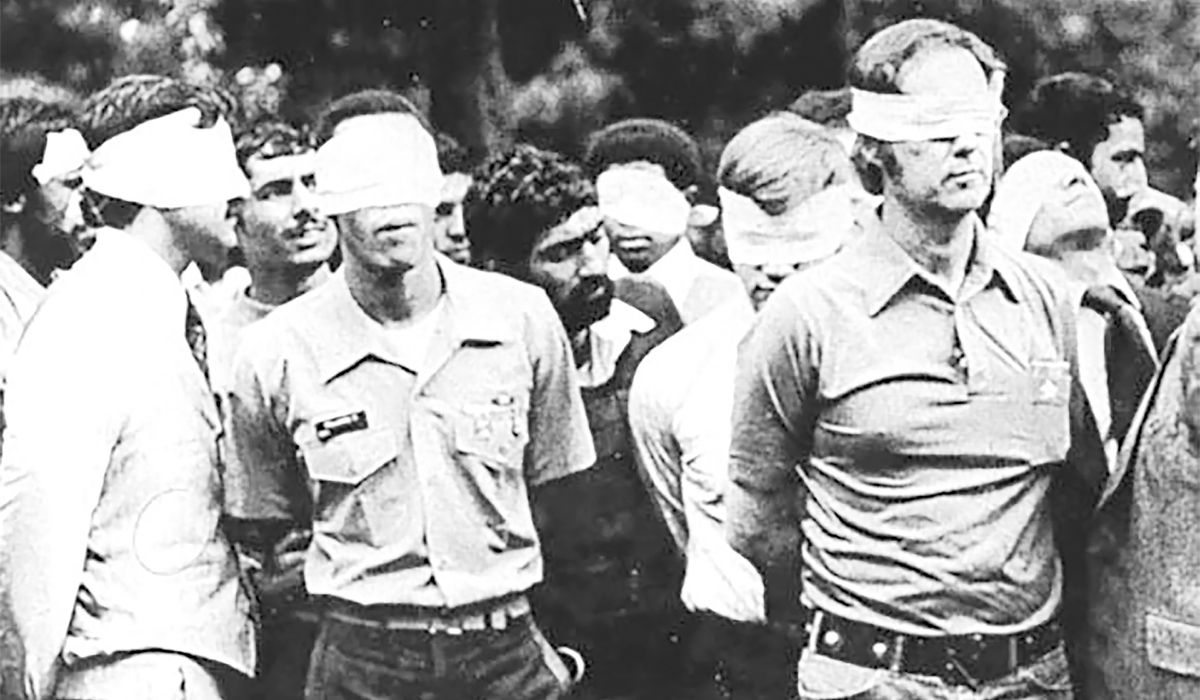
On the contrary. Having escaped unscathed, Iran’s regime has felt free to target dissidents, opponents, Israelis, and Jews in a global campaign of assassinations and bombings. In 1994, Iran engineered the bombing of the Asociación Mutual Israelita Argentina in Buenos Aires, a crime which, until the October 7 Hamas massacre, constituted the largest mass murder of Jews since the Holocaust. In 2022, Britain’s MI5 reported at least 10 attempts by Iran to kidnap or kill British-based individuals considered “enemies of the regime”. This campaign of death continues today and extends to the territory of the United States. The Department of Justice has accused Iran of plotting to assassinate former National Security Advisor John Bolton, former Secretary of State Mike Pompeo, and journalist Masih Alinejad. President Trump himself has been identified as a target.
Under its present government, Iran represents a threat to world peace. It is committed to a campaign of enriching uranium to a level where it can be used for nuclear weapons. This campaign was stymied by the U.S. bombing of the nuclear facilities at Fordow, Natanz, and Isfahan in June, but the regime has vowed to rebuild those sites “stronger than before.” Iran has never made a secret of its purpose. Its former President Mahmoud Ahmadinejad has called Israel “a disgraceful blot” that should be “wiped off the face of the earth.” Its Supreme Leader Ali Khamenei has said that Israel “will not survive another 25 years.”
The world is full of malevolent dictatorships, hostile to the United States. But Iran is unique. Russia does not seize our embassies and imprison our diplomats. China does not send assassins to our shores to murder government officials. North Korea, though ruled by a bombastic and vicious dictator, does not train terrorist organizations to rape and murder. The leaders of these countries may be cruel and evil, but they are basically rational.
Iran’s leadership is different, and the difference lies in theology. Members of Iran’s leadership subscribe to an apocalyptic vision of the world holding that war is a necessary precursor for the return of the Mahdi, the 12th Iman. This makes them more willing to accept, and even to hope for, a violent confrontation with the secular West, for such a cataclysm will accelerate the Mahdi’s return.
Ridding the world of this barbaric, benighted regime would be a moral act. It would likely lead to the establishment of a more secular, more tolerant government, to the benefit of the Iranian people. And it would engender a host of pragmatic benefits for the United States.
First, and most obviously, it would eliminate a major adversary, one committed to doing everything in its power to harm our country, up to and including murdering our President.
Second, it would help stabilize the Middle East. The biggest regional threats to that stability are the Hamas, Hezbollah, and Houthi terrorist organizations, all nurtured and financed by Iran’s regime. Eliminating Iran’s ability to support them might not usher in a Golden Age of Peace in that troubled region. Centuries old conflicts and struggles would continue to exist. But it would certainly lower the temperature. Regional strife would become more like the “normal” conflicts that competitive nations with adverse interests traditionally confront.
Third, ousting the regime would reduce Chinese and Russian influence in the region, since the regime’s successor would assuredly be more pro-American than the current hostile one.
What can the United States do to help the Iranian people oust their dictatorial rulers? Plenty. And it can do so without placing “boots on the ground.”
The U.S. can restore and expand internet access. One of the first steps taken by the ruling clique was to shut down the internet, preventing dissident elements from communicating with each other and thus impeding a coordinated campaign of resistance. The shutdown also serves the regime by preventing the circulation of visual evidence of its atrocities (of which, sadly, there have been many). Working with tech companies, the United States should implement measures to bypass the government shutdown. This will enable dissidents to work together. It will also allow ordinary, uncommitted citizens to see what their government is doing, and to take sides.
Next, turning the government shutdown on its head, the U.S. should help shut down or interfere with the regime’s communications, leaving them blind, disorganized, and confused.
Going even farther, we could help the protestors use the internet to publicize personal information about the thugs who are carrying out the murderous directives of the mullahs. Who are they? What are their addresses? The regime will find it difficult to find goons willing to carry out its grisly objectives if those goons know that their identities will be publicly disclosed. Some may even choose to desert, or to join the other side.
The United States could provide financial support to workers on strike against government facilities. During the Cold War, such support helped organizations like Solidarity undermine and ultimately overthrow the Soviet bloc puppets.
Skeptics of U.S. involvement might note that there have been protests in Iran before, including uprisings in 2009, 2017-2018, 2019-2020 (“Bloody Aban”), and 2022-2023 (after the murder of the 22-year old Kurdish woman Mahsa Amini). Why should the current wave of dissent lead to its ouster when those previous uprisings did not? After all, the mullahs’ regime has never relied on popularity to maintain its hold on power. It has relied on force and fear.
Admittedly, there is no guarantee of success. But there are credible reasons to believe that the regime truly is on its last legs, ready for toppling.
As bad as economic conditions have been in the past, they are worse now. The rial, Iran’s currency, was at 70 to the U.S. dollar when the mullahs took over in 1979. Today, the rial has become essentially worthless; its exchange rate is 1.42 million to the dollar. Food inflation has exceeded 70%. This affects not only ordinary citizens. It also affects the goons sent to crack down on them. After all, goons have to eat too. At some point, they may choose to join the rioters instead of shooting them.
Adding to this economic misery is the fact that the country is facing an unprecedented water crisis due to government mismanagement. There is rationing in the cities, and a real possibility that the government will be forced to relocate its capital from Tehran to a wetter, coastal region, a project that would likely take decades and cost one hundred billions dollars. Nothing like this was happening during past protests.
Instead of using its resources to face these daunting challenges, the government has chosen to waste vast sums on enriching uranium and on subsidizing Hamas, Hezbollah, and the Houthis. Today, those nuclear facilities lie buried under tons or rubble, and Hamas, Hezbollah, and the Houthis are largely neutralized. “No to Gaza; no to Lebanon; my life only for Iran” has become a popular chant. Now, for the first time, the protestors have irrefutable proof that the billions spent by the regime have been a colossal waste.
Yet another reason for believing that the regime is on its last legs is its display of military impotence. Last June, Israeli aircraft achieved complete mastery of Iranian airspace, allowing American bombers with bunker-busting ordinance to freely enter and destroy the nuclear enrichment facilities. Top military leaders and nuclear scientists were killed in a surgical campaign of targeted assassinations, a campaign that resulted in virtually no collateral damage. These disasters demonstrated the weakness of the regime – and weakness emboldens dissidents and invites challengers.
Finally, and despite his erratic record, President Trump represents a new variable in the equation. Trump has shown a willingness to resort to military power. The American seizure of Venezuelan leader Nicolas Maduro – snatched along with his wife out of their bedroom, surrounded by thousands of Venezuelan and Cuban guards — was an incredible demonstration of American military prowess. It was a demonstration likely to unnerve the men around the mullahs, and to shake their loyalty.
Taken together, these factors have left the regime weakened and wobbly to an extent that simply did not exist in the past. We are operating in a different world with different circumstances. A strong push by the United States now might lead to the regime’s demise.
In Act IV of Julius Caesar, Brutus states:
There is a tide in the affairs of men
Which, taken at the flood, leads on to fortune;
Omitted, all the voyage of their life
Is bound in shallows and in miseries.
President Trump may not read much classical literature, but at some point he has probably read or heard that speech. Such a tide now washes against his feet. Will he take it at its flood? Or will Trump, distracted by trivial matters, allow this tide to recede? Trump is keenly sensitive to his place in history. Now is the time to burnish it.
 toputitbluntly.com
Counter-revolutionary success is very rare. As for your specific steps: If the thugs control the physical international links, they control internet access. No way around it, except Starlink or ham radio. It may be possible to shut down IRGC communications, but that should wait for a time when it will have maximum impact – in the meantime, better to listen in. Anyway, the Abraham Lincoln CSG is steaming toward the Gulf so we may witness another application of kinetic energy.