
As the war against Iran continues, a growing domestic chorus is proclaiming that the United States has been manipulated into fighting a war more in Israel’s interests than our own.
The loudest of such voices belong to those with impeccable anti-Semitic credentials. Tucker Carlson warns that the U.S. is “tethered” to Israel, like a pet or a small child. Marjorie Taylor Greene declares that MAGA has been supplanted by “Make Israel First.” The clear leader in the lunatic wing is Candace Owens, who asserts that Turning Point USA founder Charlie Kirk was killed “for this war.”
Like most conspiracy theories, the manipulation myth does not withstand scrutiny. The truth is that the United States is following the course of action which it deems best for itself. One may agree or disagree with this choice, but President Donald Trump is nobody’s fool. He is certainly nobody’s puppet.
This does not mean that American and Israel’s objectives are identical in every respect. The objectives of allies at war rarely are. America has a long history of waging war alongside allies with different, sometimes conflicting, interests. One can trace that history all the way back to the Revolution, which we fought alongside our oldest ally, France. The United States fought the Revolution to establish a free and independent republic based on individual rights. The French monarchy wasn’t particularly interested in such aims. It just wanted to win back some of the possessions it had lost to the British a few years earlier in the French and Indian War (known outside North America as the Seven Years War). But the alliance worked well for both parties.
The United States and Israel vary in population, location, size, and history. It would be astonishing if their war aims did not diverge to some extent. But most of the supposed differences tend to disappear upon close examination.
For example, some analysts argue that the United States and Israel have conflicting interests regarding stability in the Middle East. According to this theory, America wants a stable Middle East, while Israel favors instability and chaos in the Muslim world. Curt Mills, the Executive Director of the American Conservative, framed the issue in an interview on the Christopher Rufo substack:
The Israelis have explicitly stated that they’re fine not just with regime change, but with state collapse in Iran. State collapse means that you slice off regions rife with ethnic conflict, you destroy the Iranian nation, and you ultimately create a civil war—a bunch of small, warring statelets.
That might work for a certain Israeli frame of mind that holds that every geopolitical actor in the Muslim world should be weak, that you need to slice and dice the region, and that you can never trust any of these people…. But I don’t see how such a situation is good for American interests. If America has any interest in the Middle East, it’s promoting regional stability.
This is incorrect is all respects.
Israel has long sought a Middle East region of stable and, if not friendly, at least non-belligerent neighbors. In 1970, Israel stationed ground troops and positioned its air force to safeguard the royal government of Jordan against a Palestinian assault backed by Syria. It was not a matter of friendship. Israel and Jordan had just fought a war against each other three years earlier. It was, instead, a manifestation of Israel’s longstanding and pragmatic policy of promoting a stable neighborhood.
Iran itself provides evidence of Israel’s interest in stability. From Israel’s founding in 1948 until the Iranian revolution of 1979, Israel and Iran enjoyed relatively friendly and constructive relations. Iran supplied Israel with oil, and Israel provided weapons and military intelligence to Iran. No country on earth has suffered more from the destabilizing repercussions of Iran’s 1979 upheaval than Israel.
Today, Israel would like nothing better than a stable government in Lebanon, a country that exemplifies the kind of “small, warring statelets” decried by Mills in the Rufo interview. Israel prefers stability because it recognizes that regional instability creates a petri dish in which terrorist viruses like Hezbollah and Hamas fester.
The strongest refutation of the manipulation myth lies in Trump himself – in his ego and self-assurance. He is not the stuff puppets are made of.
Donald Trump believes he knows best, and his self-confidence is not entirely undeserved. Trump has repeatedly taken steps in defiance of warnings by experts – and he has prevailed.
In 2017, Trump was warned by foreign leaders that moving the American embassy from Tel Aviv to Jerusalem would infuriate Muslims around the world and wreak havoc in the Middle East. He moved it anyway. The havoc never happened.
In 2020, Trump was warned by Senator Lindsey Graham and by his Chief of Staff Mick Mulvaney that assassinating Quds Commander General Qassem Soleimani would lead to “an almost total war” in the region. He killed him anyway. The total war never materialized.
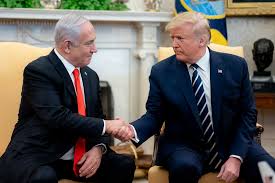
For decades, Netanyahu has been urging American presidents to attack Iran’s nuclear facilities. He has not tried to manipulate anyone. Instead, he has issued his warnings about the danger of a nuclear-armed Iran openly and publicly, just as Churchill did in his warnings about the danger of Hitler. Churchill found a kindred spirit in Franklin Roosevelt. Netanyahu found his Roosevelt in Trump: a president who needed no manipulation because he was already inclined to agree with him.
Another basis for the manipulation myth is timing. Proponents of the myth assert that Israel hurried the United States into attacking prematurely, before all diplomatic efforts had been exhausted. Again, the theory does not withstand scrutiny.
Far from urging Trump to act precipitously, Netanyahu actually encouraged him to proceed more cautiously. In January, while Trump was publicly applauding the protests in Iran, and promising the protestors that “help is on its way,” Netanyahu asked Trump to delay taking military action against Iran because he believed that both nations needed more time to prepare for the anticipated Iranian retaliation.

By late February, Israel and the United States were ready for war. In addition, Israeli intelligence identified an opportunity to wipe out the senior Iranian leadership in a single, decapitation strike. When Trump was informed of the opportunity, he agreed to the timing of the attack. But he was not manipulated into doing so. Instead, he was agreeing to undertake a course of action he was already prepared and anxious to pursue.
Trump was emboldened to take action against Iran because of the phenomenal success achieved by the U.S. military in seizing Nicolas Maduro and his wife from their bedroom in Caracas and spiriting them away to face trial in New York. Israeli leaders may have applauded this action (Israel had long viewed Venezuela as an enemy), but they had no role in it.
President Trump is not the kind of man given to introspection. He is more interested in winning than in reflection. But he seems to realize that his historical legacy will depend upon the success or failure of the war against Iran. If it succeeds, if Iran is permanently barred from acquiring a nuclear weapon, then future historians will have to concede, however reluctantly, that his presidency was a success – just as most current historians have to concede, again however reluctantly, that Ronald Reagan’s Cold War victory made his presidency a success.
Donald Trump may like and admire Benjamin Netanyahu, but he would not risk his legacy on him or on anyone else. That is why the manipulation myth is just that – a myth without any basis in reality.
 toputitbluntly.com