What do Congresswoman Lauren Boebert and Senator John Fetterman have in common?
“Not much,” might be the first reaction. Boebert is a far-right MAGA Republican. Fetterman is a left-wing progressive Democrat.
On closer inspection, however, the two share one important trait: lack of manners.
Not to put too fine a point on it, John Fetterman and Lauren Boebert are obnoxious, uncouth individuals. Most civilized people would not welcome them into their homes, even if they agreed with their politics.
These qualities were on display earlier this month.
Ours is the Age of Play Acting, in which small characters strut and fret their hour upon the stage, impersonating greater figures.
Consider Donald Trump’s mugshot, taken at the Fulton County Jail following his indictment for conspiring to interfere with the 2020 presidential election in Georgia. Trump evinces a pose of heroic defiance, a pose he clearly rehearsed. Within minutes of its being taken, the mugshot was featured on fundraising messages, and on Trump X’s (formerly Twitter) account, where it soon garnered a quarter of a billion views. Beneath the heroic visage are the stirring words: “Never Surrender.”
For his hour upon the stage, Trump chose to play Winston Churchill.
It’s a free country, and such silliness is constitutionally protected. But these antics demand to be put in perspective.
Barbie and Oppenheimer are unlikely cinematic twins. Released on the same day, they both achieved immediate, immense success. Barbiegenerated $1 billion in ticket sales in 17 days, the fastest time any Warner Bros. film has reached that landmark. Oppenheimercrossed the half billion dollar mark in the same time span, making it the highest grossest World War II movie in history.
Barbie is a playful fantasy about a Barbie doll whose arched feet suddenly flatten. She must venture out of Barbie World to the real world, to find the human owner responsible for this and other “malfunctions.” The film features colorful plastic backdrops, and rocking song and dance numbers performed by troops of Barbie and Ken dolls. There are occasional gravitas breaks for sermons on feminism, but the most part this is a movie that wants its audiences to relax and have a good time.
Oppenheimer is a 3-hour biopic about the creation of the atomic bomb. Like the critically acclaimed biography American Prometheus, upon which the movie is based, Oppenheimer takes a generally sympathetic view of its subject, portraying him as a brilliant and patriotic scientist, unfairly caught up in the Cold War hysteria following the end of the war. Whatever its editorial bias, the movie is a thoughtful work of history, accurately depicting the scientific and engineering challenges faced by Oppenheimer’s team, and even offering extensive expositions on nuclear physics.
Unlike Barbie, Oppenheimer has no songs, no dance numbers, and not a single joke. This is a movie that wants its audiences to take it seriously.
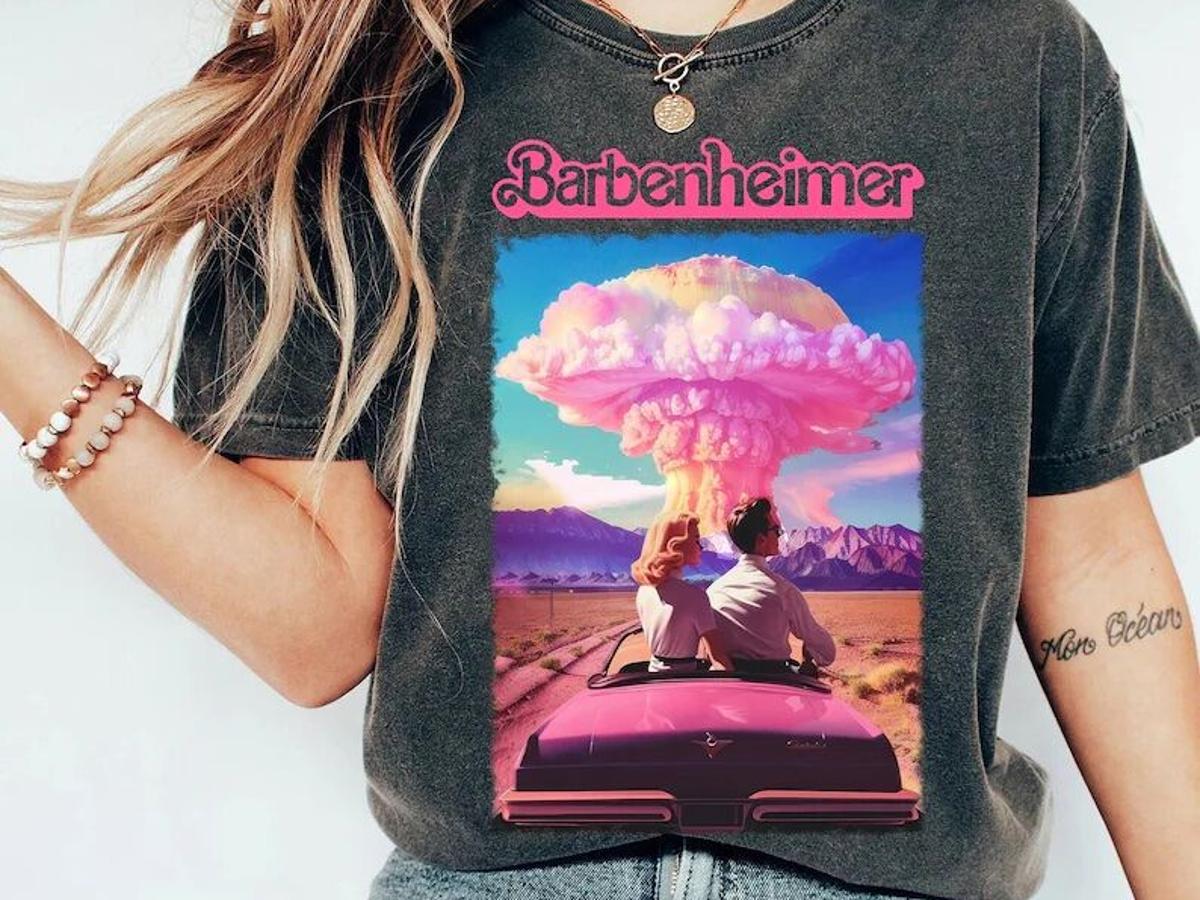
With their cosmic content differences, one might expect the movies to appeal to vastly different audiences. Surprisingly, there has been much overlap in viewership. On opening weekend, 200,000 viewers paid for tickets to see both. Culturally, “Barbenheimer” has become a meme, with t-shirts showing Barbie and Oppenheimer together watching a pink mushroom cloud rising over the desert.
I met a trout in Western Colorado. This fish was full of self-confidence, and knew no haste. Because I could not rise for him, he kindly rose for me.
The meeting occurred on Mesa Lake, at an elevation of 10,500 feet. My college friend Victor, an avid fisherman knowledgeable in the ways of Colorado trout, took me to this place. We had to drive through snow and 35 degree weather to reach the lake, but I was glad we did. It was clean and cold and pristine.
We fished without success for most of the day. Though I saw many rises, the fish were not interested in what I was offering. Trout are like that. They are the finickiest animals alive. Once, I set down a Renegade with a respectable cast and watched it float next to a real aquatic insect. From a distance, the two looked alike, and I was just congratulating myself for my success in matching the hatch when a discerning trout rose up and snatched the real thing, ignoring my fly mere inches away. This trout displayed not the slightest hesitation or ambivalence in choosing. We anglers may flatter ourselves in selecting and casting our flies accurately, but trout are not easily impressed.
My encounter occurred in the afternoon, just before we had planned to leave. I was fishing with a simple Caddis fly, of which I carry many. Suddenly I felt that peculiar tug, which triggers the release of adrenaline and sets the nerves tingling no matter how many times it is experienced. The rod, previously straight, bent at an ungainly angle. This tug was more than peculiar. It was powerful. I knew I had hooked a large fish. Reflexively, I pulled back and set the hook. Usually, when a hook is set, the fish dives down into deeper water. But this fish did something different. Instead of diving down, he rose up, high above the surface. He wasn’t thrashing to escape. He was showing off, flaunting his size and beauty.
I had a good look at him, all 20 inches of rainbow, I would say. (Inevitably, his size will grow in future retellings.)
Then he was below the surface again, and I was slowly leading him toward the shore, careful to keep the line taut, as he grudgingly accepted or seemed to accept his fate. The tension in the line was interspersed with the trout’s struggles, which pulsed through the line.
And then, as the line, fly, and fish all neared the shore, the tension changed. It no longer jerked spasmodically. The tension was constant and consistent.
The trout had shrewdly dived under a log, and the tension I was feeling was not the struggling trout, but only the steady pull against the log. The line itself was caught on the underside of the log, allowing the trout to shake itself free of the hook and escape.
It was about time to go, and Victor was already taking off his boots and waders. The trout, in his temerity, had allowed me to get a good look at him as he rose above the surface and hung there in the air, his body contorting with piscine power. I was sad to lose such a magnificent trout, but I should not have been. If he hadn’t made it to safety under the log, if I had succeeded in bringing him to the shore, the result would have been the same. I would have extracted the hook as quickly as possible (trout cannot live out of water for long), and eased him back into the lake. The trout had simply de-hooked himself, doing the work for me. So there was little cause for regret.
Victor had had a similar experience, hooking a fish but losing it before he could bring it to shore. Still, we were both happy as we drove down from the mesa, to his home. We reminisced about college courses and co-eds of 50 years ago, and we laughed. I thought of the trout that got away, and imagined him gliding across his cold, watery domain, also laughing.
On Monday night, Buffalo Bills safety Damar Hamlin, in the course of what appeared to be a routine tackle, received a hard hit to the chest. He got up from the turf, stepped backward, then collapsed.
Since his fall, the public has fixated on Hamlin’s condition. By the time the game was officially suspended with 5:58 left in the first quarter, it had become the most watched “Monday Night Football” game in ESPN history. The story was front page news on the New York Times for three consecutive days, matching the coverage devoted to the vote for House Speaker and the war in Ukraine . Hamlin’s online toy drive, which had a goal of $2,500 before his collapse, soon topped $8 million in donations. President Biden called Hamlin’s parents to offer support, then tweeted about it.
Why the fascination? Damar Hamlin is a well-respected and well-liked athlete, but he hardly qualifies as a superstar. He was a 6th round draft pick in 2021, and was used sparingly in his rookie year. He did not win a starting position until September, when his teammate Micah Hyde suffered a neck injury. It is safe to say that before his collapse, few sports fans outside Buffalo knew much about him. Yet he has become a national celebrity, with millions of people, including many who do not even follow football, keeping up with the daily medical updates and praying for his recovery.
The answer may lie in the trade that we strike with the superbly conditioned men and women who entertain us by playing professional sports. They are our heroes. But they are not our gods. The distinction is important and relevant to the trade.
My wife, who rises earlier than I do because she has the morning dog-walking duties, woke me the other day to tell me that Thatcher was not moving.
Thatcher is a Goldendoodle or “Groodle,” a species developed in the 1990s by crossing a Golden Retriever with a Poodle. She joined our family about the same time our youngest child graduated high school and headed off to college. Thanks to Thatcher, we did not become empty-nesters.
The previous day, my wife had taken her on a five mile hike. That night, she lay by my feet in the living room, asleep by the fire, while I binged on White Lotus. When I got up to go to bed, I stepped over her carefully and wished her a good night. Sometime that night, she had stirred, moved to our bedroom, lain down, and died quietly without disturbing us.
When my wife woke me, Thatcher was lying beside our bedroom door, facing toward the patio. It appeared that she had been thinking of going out. Instead, she died as she had lived, causing no trouble.
She was just shy of 13, a long life for a dog.
Thatcher had the sweetest disposition an animal could have. She was visibly overjoyed when anyone – friend, relative, postman, deliveryman — rang the bell. She raced to the door to welcome the visitor and to ascertain by a hurried nasal inspection where he had recently been, whether he had pets, and whether he was carrying treats. She held a firm conviction that any creature walking on two legs was put on Earth to play with her.
Unless you are a hermit, you have probably listened to a “land acknowledgment.” These are short statements uttered before social gatherings, acknowledging the prior possession of the land on which the events are taking place by indigenous peoples. Originating in Australia, New Zealand, and Canada, they have become popular in the United States, and are now regular features in theaters, sports arenas, academic conferences, college commencement ceremonies – and even private family gatherings.
Land acknowledgment details may differ depending upon the event and the attendees, but certain characteristics apply more or less consistently. The statement is delivered in solemn and serious tones. The Indian tribe or tribes identified in the statement are portrayed as innocent victims, and their land described as “ancestral” or “unceded,” thus implying that the non-Indian attendees are trespassing. For the most part, the statements are gentle. Few go as far as the Northern California ACLU, whose website advises readers that land acknowledgment statements help us “confront our own complicity in genocide.”
These statements do carry educational value. They remind us that the conquest of the North American continent by settlers of European heritage was accompanied by massive, often monstrous mistreatment of the native peoples. And learning about the people who earlier inhabited one’s place of birth or residence is always a laudable undertaking.
Yet at the same time that land acknowledgments have proliferated, so have criticisms.
Thirty two years ago, a San Jose State University English professor named Shelby Steele published a short book entitled The Content of Our Character: A New Vision of Race in America. Steele perceived an unholy bargain between white and black Americans. Under its terms, whites, burdened with guilt for their history of discrimination, would exercise the power to bestow preferential treatment on blacks, and in return blacks, commanding the asset of innocence, would exercise the power to bestow absolution on whites.
Steele deemed the bargain harmful for both sides, but especially so for blacks:
I think the reason there has been more entitlement than development is … the unacknowledged white need for redemption – not true redemption, which would have focused policy on black development, but the appearance of redemption which requires only that society, in the name of development, seem to be paying back its former victims with preferences. One of the effects of entitlements, I believe, has been to encourage in blacks a dependency both on the entitlements and on the white guilt that generates them.
Last month, in a letter to the “Members of the Harvard Community,” President Lawrence Bacow announced the release of a 134-page report documenting the history of Harvard’s “extensive entanglements” with slavery. At the same time, President Bacow announced a $100 million commitment to implement the authors’ recommendations on “how we as a community can redress – through teaching, research, and service – our legacies with slavery.”
Is this an exercise in true redemption? Or is it an engagement in the kind of superficial trade-off that Shelby Steele analyzed three decades ago?
Sigmund Freud, pop psychologists, and even Mel Gibson have pondered: What do women want? This post explores a different but equally important question: What do men want?
Conventional wisdom holds that men want sex — and plenty of it. Also wealth. And fame. And power. And then more sex, please.
Of course, men want those things. But there is something else they want even more. Something less physical, less palpable, but prized all the more for its ethereal value. Every man wants to see reflected upon his beloved’s face a look of pure adoration. Men want to see what we may call the “Ilsa Face.”
This is the face that Ingrid Bergman, as Ilsa Lund, casts upon Paul Heinreid, as Victor Laszlo, in Casablanca.
To discover the Ilsa Face, one must turn to the 40-second “La Marseillaise” scene. Here is a link to it. Readers may wish to take the time to watch before we move on to explore what men want.
The latest justification for censorship is the need to suppress “misinformation.” The enemies of misinformation see themselves, not as censors, but as public guardians engaged in a campaign of self-defense.
Critics of Joe Rogan have justified their efforts to pressure Spotify to drop his popular podcast by accusing him of endangering the public health by hosting guests skeptical of the Covid vaccines.
In his defense, Rogan posted a 10-minute video on Instagram, in which he addressed the subject of misinformation generally. Rogan gave three examples of contentions which were once deemed “misinformation,” but which are now either accepted as true or at least considered plausible: 1) even if you are vaccinated, you can still catch and spread Covid; 2) cloth masks don’t work; and 3) Covid came from a lab leak.
Rogan, a former stand-up comedian and ultimate fighting commentator, does not fit the classical profile of an intellectual. And one might quarrel with his descriptions of these contentions (for example, while experts have long advocated the use of masks, there has never been widespread advocacy of cloth masks in particular).
But Rogan’s basic point is valid and perceptive: yesterday’s “misinformation” may become tomorrow’s accepted truth. Indeed, Rogan may have understated his case.









 toputitbluntly.com