“Apartheid” is an official government program of racial segregation, which authorizes discrimination in the political, legal, and economic spheres. No such system exists in Israel.
Arab Israelis, who constitute 21% of the population, enjoy the same civil rights as Jewish Israelis. They serve as elected representatives in the Knesset and as judges in Israeli courts. An Arab Israeli, sitting on the Supreme Court, authored the decision upholding the rape conviction of a former President of Israel. They are also culturally integrated. In 1999, an Arab Israeli woman was crowned Miss Israel. In 2016, an Arab Israeli was crowned Miss Trans Israel.
If you want to see the absurdity of calling Israel an “apartheid” state, attend a soccer game when the popular Maccabi Haifa team is playing. Two of the team’s biggest stars are Arab Israelis, Dia Saba and Mahmoud Jaber. The team roster includes players of four different religions: Judaism, Christianity, Islam and Druze. Messay Dego, a member of Israel’s Ethiopian community, is the team’s first black head coach.
Arab Israelis are exempt from the draft, but many thousands of them volunteer to serve in the IDF.
It is also worth noting that a majority of Israeli Jews are Sephardic, meaning that they are of Middle Eastern or North African descent. In the United States, such people would be perceived as “people of color,” not white. So the term “apartheid” doesn’t even make sense when applied to Israel.
Finally, a racist “apartheid” state would not have gone to great lengths, as Israel did, to transport thousands of oppressed Ethiopian Jews out of Africa to Israel. Throughout history, many nations have removed Africans from that continent to subject them to slavery. Israel alone among the nations of the world has rescued Africans from that continent to elevate them to freedom.
Abundant archeological evidence shows a continuous Jewish presence in Israel since the Hebrews’ return from Egypt circa 1200 BCE. Arabs did not arrive in this geographic area until 640 CE, nearly 2,000 years later.
The British, French, and other Europeans who established colonies in Africa are examples of true “colonists” They colonized regions in which they had never lived before, and to which they had no spiritual or cultural connection. The American pioneers who settled the Western frontier are examples of true “settlers.” They settled territories in which they also had never lived before, and to which they had no connection.
In contrast to the European colonists and the American settlers, Jews have always been deeply connected to what the Bible refers to as Eretz Yisrael, the Land of Israel.
Because of the forced expulsion by the Romans, most Jews were dispersed throughout the world, a phenomenon known as the Diaspora. But some always remained in Israel, fostering a continuous Jewish presence for over three thousand years. For Jews in the Diaspora, a special spiritual connection to the Holy Land persisted even if a physical connection did not. “Next year in Jerusalem” is recited by Jews the world over at Passover. The Shulchan Aruch, the Jewish legal code compiled in the 16th century, states that a Jew who comes to pray should face the Land of Israel. At weekly Sabbath services, Jews read a portion of the Torah, the first five books of the Old Testament. The Torah mentions Jerusalem more than 660 times, further proof of the deep Jewish connection to Israel.
In short, Jews are and have always been an indigenous people of the Holy Land, with deep religious connections.
Calling Jews “colonists” or “settlers” of Israel may fit the trendy “intersectionality” jargon common on many college campuses these days. But it’s a historical fiction.
George Orwell famously observed that “there are some ideas so absurd that only an intellectual could believe them.” The reaction in some academic quarters to the barbarisms inflicted on civilians in Israel by Hamas murderers illustrates the obverse: There are some facts so obvious that only an intellectual could fail to believe them.
Here are some of those obvious facts. On October 7, members of Hamas penetrated the border with Israel and proceeded to conduct a murderous rampage on unarmed civilians. They raped women, shot the elderly, and burned infants. They seized about 150 traumatized civilians — again, many of them women, children, and the elderly — and carried them off to Gaza, where brutalized women were spat upon by the cheering, jeering local populace.
We know these are facts, and not mere rumors or allegations, because the perpetrators themselves filmed these actions and proudly posted them on social media.
(And by the way, could we please stop referring to the perpetrators as “militants” or “fighters”? Armed men who butcher women, babies, and the elderly do not fit the definitions of those terms. We do not say that “German militants” killed millions of Jews in concentration camps. We do not say that “Hutu fighters” killed 800,000 Tutsis in Rwanda.)
Sensible people, regardless of their views on the geopolitics of the Middle East, can readily understand that these heinous facts must be condemned. But — referring back to the obverse of Orwell’s observation — there are some facts so obvious that only an intellectual could fail to believe them.
Unfortunately, Harvard is an incubator of such intellectuals.
What do Congresswoman Lauren Boebert and Senator John Fetterman have in common?
“Not much,” might be the first reaction. Boebert is a far-right MAGA Republican. Fetterman is a left-wing progressive Democrat.
On closer inspection, however, the two share one important trait: lack of manners.
Not to put too fine a point on it, John Fetterman and Lauren Boebert are obnoxious, uncouth individuals. Most civilized people would not welcome them into their homes, even if they agreed with their politics.
These qualities were on display earlier this month.
Ours is the Age of Play Acting, in which small characters strut and fret their hour upon the stage, impersonating greater figures.
Consider Donald Trump’s mugshot, taken at the Fulton County Jail following his indictment for conspiring to interfere with the 2020 presidential election in Georgia. Trump evinces a pose of heroic defiance, a pose he clearly rehearsed. Within minutes of its being taken, the mugshot was featured on fundraising messages, and on Trump X’s (formerly Twitter) account, where it soon garnered a quarter of a billion views. Beneath the heroic visage are the stirring words: “Never Surrender.”
For his hour upon the stage, Trump chose to play Winston Churchill.
It’s a free country, and such silliness is constitutionally protected. But these antics demand to be put in perspective.
Barbie and Oppenheimer are unlikely cinematic twins. Released on the same day, they both achieved immediate, immense success. Barbiegenerated $1 billion in ticket sales in 17 days, the fastest time any Warner Bros. film has reached that landmark. Oppenheimercrossed the half billion dollar mark in the same time span, making it the highest grossest World War II movie in history.
Barbie is a playful fantasy about a Barbie doll whose arched feet suddenly flatten. She must venture out of Barbie World to the real world, to find the human owner responsible for this and other “malfunctions.” The film features colorful plastic backdrops, and rocking song and dance numbers performed by troops of Barbie and Ken dolls. There are occasional gravitas breaks for sermons on feminism, but the most part this is a movie that wants its audiences to relax and have a good time.
Oppenheimer is a 3-hour biopic about the creation of the atomic bomb. Like the critically acclaimed biography American Prometheus, upon which the movie is based, Oppenheimer takes a generally sympathetic view of its subject, portraying him as a brilliant and patriotic scientist, unfairly caught up in the Cold War hysteria following the end of the war. Whatever its editorial bias, the movie is a thoughtful work of history, accurately depicting the scientific and engineering challenges faced by Oppenheimer’s team, and even offering extensive expositions on nuclear physics.
Unlike Barbie, Oppenheimer has no songs, no dance numbers, and not a single joke. This is a movie that wants its audiences to take it seriously.
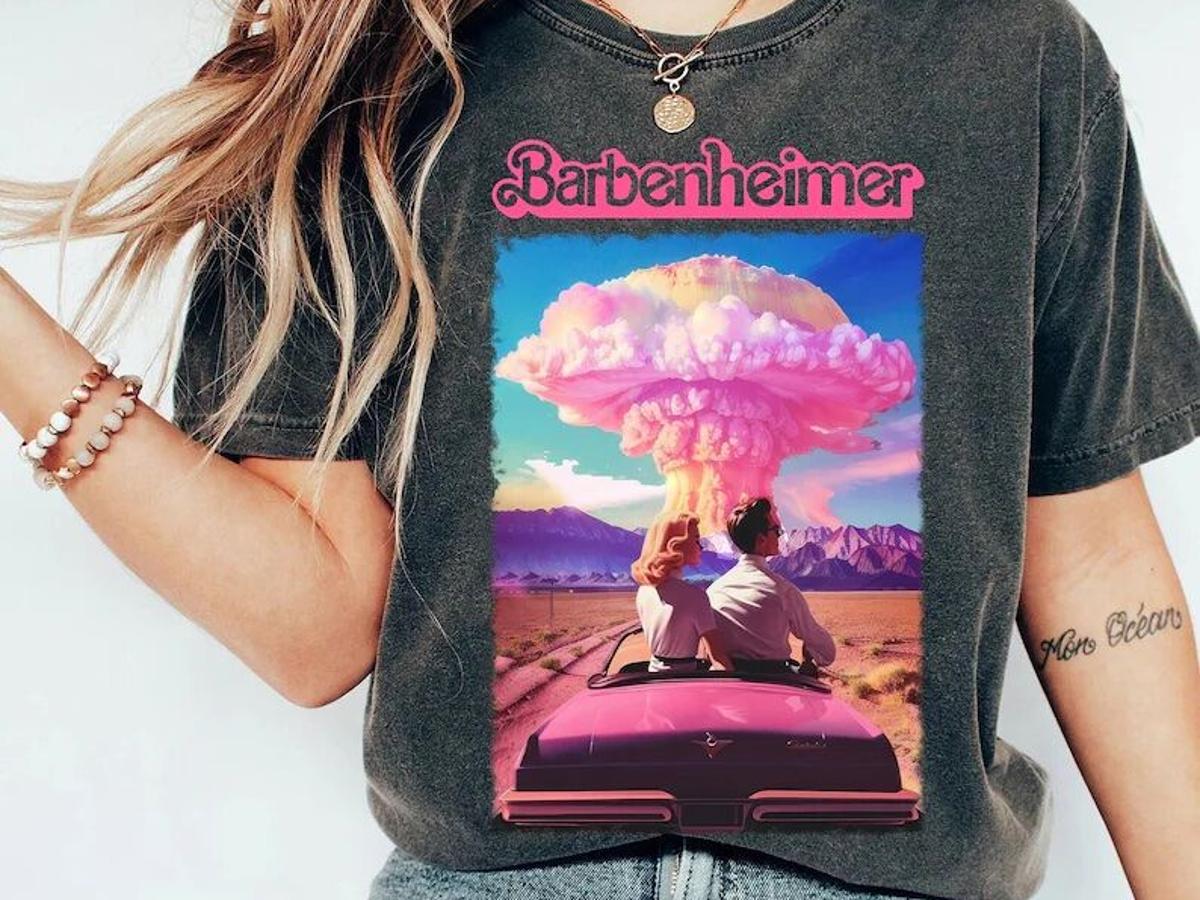
With their cosmic content differences, one might expect the movies to appeal to vastly different audiences. Surprisingly, there has been much overlap in viewership. On opening weekend, 200,000 viewers paid for tickets to see both. Culturally, “Barbenheimer” has become a meme, with t-shirts showing Barbie and Oppenheimer together watching a pink mushroom cloud rising over the desert.
No sooner had the Supreme Court released its decision in Students for Fair Admissions v. Harvard, than Harvard, the losing party, released a statement of its own by President-elect Claudine Gay. The statement was apparently prepared in advance, in anticipation of a judicial defeat. Gay, while expressing Harvard’s intention to comply with the Court’s decision, struck a pose of defiance: “We will comply with the Court’s decision, but it will not change our values.”
She did not say what those values were.
She added that the decision “has … strengthened our resolve to continue opening doors.”
She did not mention the fact in opening its doors to some, Harvard has been closing them to others; namely Asian Americans.
Harvard’s post-decision statement represented a missed opportunity. This was the moment for Harvard to own up to its discrimination against Asian Americans and to apologize.
An apology would not have required Harvard to repudiate its admissions policies, far less to admit guilt. Harvard could have still insisted that its actions, in its view, were legal and moral, and that the law would ultimately vindicate it. It could have asserted that any harm done to Asian Americans was the unfortunate but unavoidable cost of remedying greater harms.
An apology would merely have required Harvard to acknowledge that in addressing what it sees as a long history of oppression of blacks by whites, Harvard has been hampering and harming Asian Americans.
I met a trout in Western Colorado. This fish was full of self-confidence, and knew no haste. Because I could not rise for him, he kindly rose for me.
The meeting occurred on Mesa Lake, at an elevation of 10,500 feet. My college friend Victor, an avid fisherman knowledgeable in the ways of Colorado trout, took me to this place. We had to drive through snow and 35 degree weather to reach the lake, but I was glad we did. It was clean and cold and pristine.
We fished without success for most of the day. Though I saw many rises, the fish were not interested in what I was offering. Trout are like that. They are the finickiest animals alive. Once, I set down a Renegade with a respectable cast and watched it float next to a real aquatic insect. From a distance, the two looked alike, and I was just congratulating myself for my success in matching the hatch when a discerning trout rose up and snatched the real thing, ignoring my fly mere inches away. This trout displayed not the slightest hesitation or ambivalence in choosing. We anglers may flatter ourselves in selecting and casting our flies accurately, but trout are not easily impressed.
My encounter occurred in the afternoon, just before we had planned to leave. I was fishing with a simple Caddis fly, of which I carry many. Suddenly I felt that peculiar tug, which triggers the release of adrenaline and sets the nerves tingling no matter how many times it is experienced. The rod, previously straight, bent at an ungainly angle. This tug was more than peculiar. It was powerful. I knew I had hooked a large fish. Reflexively, I pulled back and set the hook. Usually, when a hook is set, the fish dives down into deeper water. But this fish did something different. Instead of diving down, he rose up, high above the surface. He wasn’t thrashing to escape. He was showing off, flaunting his size and beauty.
I had a good look at him, all 20 inches of rainbow, I would say. (Inevitably, his size will grow in future retellings.)
Then he was below the surface again, and I was slowly leading him toward the shore, careful to keep the line taut, as he grudgingly accepted or seemed to accept his fate. The tension in the line was interspersed with the trout’s struggles, which pulsed through the line.
And then, as the line, fly, and fish all neared the shore, the tension changed. It no longer jerked spasmodically. The tension was constant and consistent.
The trout had shrewdly dived under a log, and the tension I was feeling was not the struggling trout, but only the steady pull against the log. The line itself was caught on the underside of the log, allowing the trout to shake itself free of the hook and escape.
It was about time to go, and Victor was already taking off his boots and waders. The trout, in his temerity, had allowed me to get a good look at him as he rose above the surface and hung there in the air, his body contorting with piscine power. I was sad to lose such a magnificent trout, but I should not have been. If he hadn’t made it to safety under the log, if I had succeeded in bringing him to the shore, the result would have been the same. I would have extracted the hook as quickly as possible (trout cannot live out of water for long), and eased him back into the lake. The trout had simply de-hooked himself, doing the work for me. So there was little cause for regret.
Victor had had a similar experience, hooking a fish but losing it before he could bring it to shore. Still, we were both happy as we drove down from the mesa, to his home. We reminisced about college courses and co-eds of 50 years ago, and we laughed. I thought of the trout that got away, and imagined him gliding across his cold, watery domain, also laughing.
Copyright and Artificial Intelligence (AI) may be on a collision course. The capacity to comb through vast troves of data to generate arguably novel stories, poems, artwork, music, and other expressive works, gives rise to an array of tough legal issues.
Are the generated works truly original and therefore subject to copyright? If so, who owns the copyright? And what scope of protection does such a copyright confer?
Answering these questions poses formidable challenges. But it’s important to put this in perspective. We’ve been here before. Copyright and technology have collided again and again over the ages. In fact, there were collisions before there were copyright statutes. In each case, solutions were found, and copyright emerged intact or even stronger.
Pondering the possibility of American decline has become a recurring issue among commentators and pollsters. At the domestic level, it is easy to see why. Our cities are witnessing an upsurge in lawlessness, deterioration, and filth. Common items such as toothpaste are placed behind locked partitions to discourage shoplifting. Youth mobs from Chicago to Compton trash businesses and terrorize bystanders. In a development reminiscent of the Dark Ages, New York City’s rodent infestation has grown so extensive, the City has appointed its first “Rat Czar” to deal with the crisis.
But American decline is not only a domestic issue. Less visible, but equally if not more serious, are the signs of America’s decline abroad. The recently leaked military documents reveal a worrisome world in which American prestige is diminishing.





 toputitbluntly.com