Last week, Harvard’s Presidential Task Force on Combating Antisemitism and Anti-Israeli Bias issued its long awaited report. The Task Force was established in January 2024 by then-Interim President Alan Garber, and assigned to “identify causes of and contributing factors to anti-Jewish behaviors on campus; evaluate evidence regarding the characteristics and frequency of these behaviors; and recommend approaches to combat antisemitism and its impact on campus.”
There was much to identify, and it could be discovered by looking in the mirror.

Ten weeks earlier, Hamas soldiers, followed by Gazan civilians, had breached Israel’s border and engaged in an orgy of murder and rape. It was the largest death toll of Jewish people since the Holocaust. On the very day of the assault, even as Jewish mothers were being raped and slaughtered in front of their children, 34 Harvard organizations issued a statement blaming the massacre of the Jews on the world’s sole Jewish state.
In the ensuing weeks, anti-Israel encampments arose in Harvard Yard. Pro-Palestinian students disrupted classes. Visibly Jewish students were verbally bullied and physically assaulted on their way to class. Hostage posters were defaced. The President of Harvard, in testimony before Congress, declined to say that calling for the genocide of Jews violated college policies.
At 311 pages, the Task Force Report provides a wealth of information on antisemitism and anti-Israel bias. Harvard appears to be a hostile environment for Jewish students, particularly Jewish students willing to stand up for Israel. A poll conducted by the Task Force found that 67% of Jewish students felt discomfort expressing their opinions generally, and 73% felt uncomfortable expressing their political opinions specifically. Almost 60% of Jewish students reported experiencing some form of “discrimination, stereotyping, or negative bias on campus due to [their] views on current events.”
These numbers have been widely reported in the press, and deserve attention. But do they demonstrate actual bias? Perhaps they merely demonstrate the kind of victim mentality pervasive at many college campuses these days. As Greg Lukianoff and Jonathan Haidt reported a decade ago in their Atlantic Magazine essay “The Coddling of the American Mind,” college students increasingly believe that they are entitled to protection against hostile viewpoints. So who’s to say whether the Jewish students are justified in their discomfort, or are merely being overly sensitive.
Answering that question requires recognizing that the real heart of the Report is not its account of Jewish student perceptions. It is its description of Harvard University actions.
For that reason, readers should focus on the 33-page section entitled “Case Studies from Harvard’s Schools,” detailing what Harvard teaches its students. It shows that Jewish students at Harvard are more than justified in their discomfort. The Report also shows that the pro-Palestine students who camped out in Harvard Yard, who blocked access to their Jewish classmates, who defaced hostage posters, and who walked out of graduation ceremonies, were not rebels or dissidents. Those students were perfect little automatons, dutifully swallowing and regurgitating the tripe learned in their classrooms.
Former President Claudine Gay infamously told a Congressional committee that whether or not calling for the genocide of Jews violated Harvard policies “depends on the context.” The Report certainly provides “context” pertaining to Harvard University’s antisemitic and anti-Israel bias.
The following are just a few examples found as Harvard looked in the mirror.
The University has created the Palestine Program for Health and Human Rights at the François-Xavier Bagnoud Center for Health and Human Rights. Until very recently, the Palestine Program operated a study abroad program in partnership with Birzeit University. Birzeit is a Palestinian institution, whose official policy calls for an academic boycott, refusing academic contact with Israeli universities. What lessons was Harvard teaching its students when it partnered with an organization calling for a boycott of Israeli academia?
At the Harvard T.H. Chan School of Public Health, a faculty member canceled and rescheduled class, to allow students to participate in the “Palestine Solidarity Global Strike” on Friday, October 20, 2023. The date of the strike is significant. It was two weeks after the massacre, and one week before Israel launched its large-scale ground campaign in Gaza. What lessons were Harvard faculty teaching by encouraging their students to participate in an anti-Israel strike shortly after the largest massacre of Jews since the Holocaust and before the massive casualties of Gazan civilians occurred?
The same Harvard graduate school offered a 2022 course titled “Settler Colonial Determinants on Health” whose syllabus informed students that it would enable them to “analyze and interrogate the relationships between settler colonialism, Zionism, antisemitism, and other forms of racism.” Required reading included articles entitled “A Century of Settler Colonialism in Palestine: Zionism’s Entangled Project” and “Introduction: Racial Capitalism and Settler Colonialism In: Neoliberal Apartheid: Palestine/Israel and South Africa after 1994.”
The course also required students to read material arguing that “Zionism manipulated Judaism as a religion to reinterpret history and redefine Jewishness in terms of ethnic belonging.” Zionism is the belief that the Jewish people are entitled to a state in their ancestral homeland. What lessons was Harvard teaching its students by treating Zionism as a manipulator of Judaism instead of a central tenet?
At the Harvard Graduate School of Education, a course on ethnic studies assigned an article entitled “Palestine is Ethnic Studies: The Struggle for Arab American Studies in K–12 Ethnic Studies Curriculum.” The article focused on the conflict over the one-sided Ethnic Studies curriculum in the State of California’s K-12 education system. The article described two kinds of opponents to the curriculum: white supremacists and pro-Zionist organizations. In so doing, the article paired the Anti-Defamation League, the Jewish Community Relations Center, and the Simon Wiesenthal Center with white supremacists. What lessons was Harvard teaching by equating Jewish civil rights organizations with white supremacy?
The School of Education also offers a required course on white supremacy that includes this graphic:
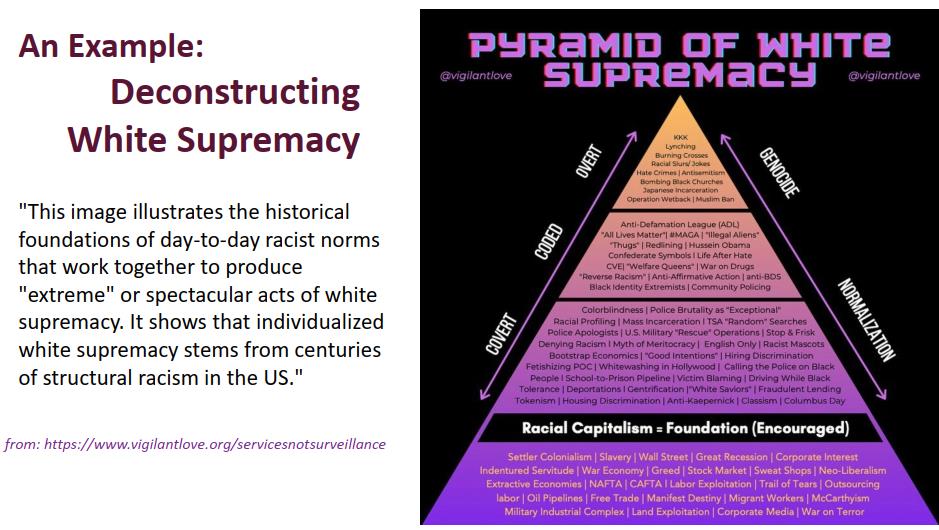
Look carefully, and the reader will see that it labels opposition to the Boycott, Divestment, Sanctions (BDS) movement as “coded genocide,” placing it alongside the Anti-Defamation League. Both are positioned merely one step removed from “overt genocide,” which includes lynching and the Ku Klux Klan. What lessons is Harvard teaching by equating opposition to the BDS movement with genocide?
Harvard’s Center for Middle Eastern Studies organized a teach-in about the Israel-Palestinian conflict on October 23, 2023, about two weeks after the massacre. A transcript of the teach-in shows that while terms such as “settler colonial,” “apartheid,” and “genocide” were frequently mentioned, the word “hostage” was never uttered even once.
Harvard’s Divinity School offers an annual trip to Israel and the West Bank. The School describes the purpose of the trip: “Dismantle the oppression of Palestinians, institute mechanisms for restorative justice, and draw ethical political maps. It is also hermeneutical, denoting the urgent need to dezionize Jewish consciousness.” What does it mean to “dezionize” Judaism? Apparently, it means that Harvard hopes to remake Judaism into a better religion by disconnecting it from the noxious idea of a Jewish homeland.
At this point in reviewing the Report, a reader might be tempted to question whether any of these course offerings, with their sometimes incomprehensible academic jargon, have any practical effect. Unfortunately, as the Report makes clear, they do.
The “Settler Colonial Determinants of Health” course ends with an assigned reading entitled “Decolonization is Not a Metaphor.” This phrase, “decolonization is not a metaphor,” has become a sick justification for the vicious and murderous rampage of October 7. The Report includes this account from a student:
In the immediate aftermath of October 7th, close friends and classmates callously dismissed the atrocities that took place in Israel. In response to a friend who knew two people who were killed at the music festival, one close friend said, “I mean, I guess that sucks, but what did they expect?” When I expressed anguish at the loss of life, another responded, “do you believe in de-colonization in theory or in practice?”
The student who posed that question may have shown callousness, but he also showed that he had paid close attention in class.
The abundant evidence of antisemitic and anti-Israeli content in Harvard courses distinguishes the Task Force on Combating Antisemitism and Anti-Israeli Bias Report from the Task Force on Combating Anti-Muslim, Anti-Arab, and Anti-Palestinian Bias Report issued the same day. The bias evidence adduced in the latter cites no discriminatory content in Harvard courses. Most of the evidence has nothing to do with Harvard. For example, the Report mentions “doxxing” 87 times. That refers to the trucks driving around the campus displaying the names and faces of the Harvard students who signed the October 7 statement blaming Israel for the Hamas-led massacre. Whatever one might think of the propriety of outing the signatories to that disgraceful statement (and it’s worth noting that Harvard Hillel condemned it), the doxxing was not done by Harvard. Those trucks were operated by Accuracy in Media, an organization with no connection to the University.
An institution of higher learning must have wide latitude in its academic offerings. Students should be conditioned to hear conflicting and controversial viewpoints, and they should be equipped to judge what is worthy and what is not.
But a university’s offerings carry an implied warranty that the content of those offerings is at least worthy of consideration, if not endorsement.
When Harvard offers its students program after program imparting the view that the Jewish people, whose connection to the Holy Land dates back three thousand years, have no connection to Israel other than as modern day settler/colonialists, the University should not be surprised at the consequences. Harvard may not have planted the antisemitic weeds overrunning the campus, but it surely has nurtured them.
 toputitbluntly.com