Category Archives: Culture

GOD EXISTS AND ROOTS FOR NEW ENGLAND

Benjamin Franklin supposedly observed that beer is proof that God loves us and wants us to be happy.  Super Bowl XLIX is proof that God exists and roots for the Patriots.

We can now close the book on “Deflate-gate,” the non-scandal about the supposed under-inflation of the footballs used by the New England Patriots in their January 18 victory over the Indianapolis Colts. For we now know the cause of the reduced air pressure.

It was not Tom Brady. It was not Bill Belichick. It was not the anonymous locker room guy. It was not even Ben Affleck or Matt Damon or the many others who bravely stepped forward to take responsibility.

God deflated the footballs. god-w.-football Continue reading

2 Comments

Filed under Culture

GOOD NEWS!

Gvetch, gvetch, gvetch.

This blog — like so many other punditic ventilators — complains a lot. In the past year, it has grumbled about political correctness, Obama’s foreign policy, lawyers, and even college reunions. And those were just the lighter essays.Good news

Negativity may attract internet traffic, but it is not humanity’s entire story. There are many positive stories lurking in the recesses of the news. Now, the afterglow of Thanksgiving, and on the threshold of the Christmas and Chanukah season, may be an appropriate time to pause and take note of five unreported or under-reported good news stories.

Continue reading

3 Comments

Filed under Culture, Law

CELLOPHANE DIVERSITY

How small of all that human hearts endure,
That part that laws or kings can cause or cure.
Samuel Johnson

In case you missed it, Silicon Valley has a “diversity problem.” That, at least, is the view of the New York Times, which published an editorial earlier this month, lamenting the fact that most Silicon Valley employees are white and Asian men. “Among technical employees,” the Times noted, “few are women, and even fewer are Latino or African-American.” The editorial noted that there is “a lot the government needs to do” to address the issue, and it urged the technology industry to “start tackling its diversity problem right now,” implying that if the industry doesn’t fix problem, the government will.cogs

We probably won’t read about it in the Times, but there are even more egregious “diversity problems” throughout the economy. For once you assume, as the editorial does, that any divergence between the demographic profile of the population at large, and the demographic makeup of a particular industry, represents a “problem” – why then, in the words of a famous Broadway hustler, “we’ve surely got trouble, right here in River City.”

If anyone wants to “start tackling a diversity problem right now,” they should start with the Cambodians. This ethnic group comprises 0.09% of the national population, less than one tenth of one percent. Yet here in California, 90% of the doughnut shops are owned by Cambodians. In other words, Cambodians are one thousand times over-represented in the doughnut industry, at least by the logic of the Times. That means that whites, blacks, Latinos, and all of us who are not Cambodian are dramatically under-represented in the doughnut business.

Continue reading

17 Comments

Filed under Culture

COMPANY LOVES MISERY

Last week, one of the nation’s premier institutions of higher learning held its 40th year reunion. Members of the Class of 1974 left their corner offices, boardrooms, television studios, summer estates, and – yes – even their comfortably ordinary jobs and homes, to reconnect with old friends and classmates.

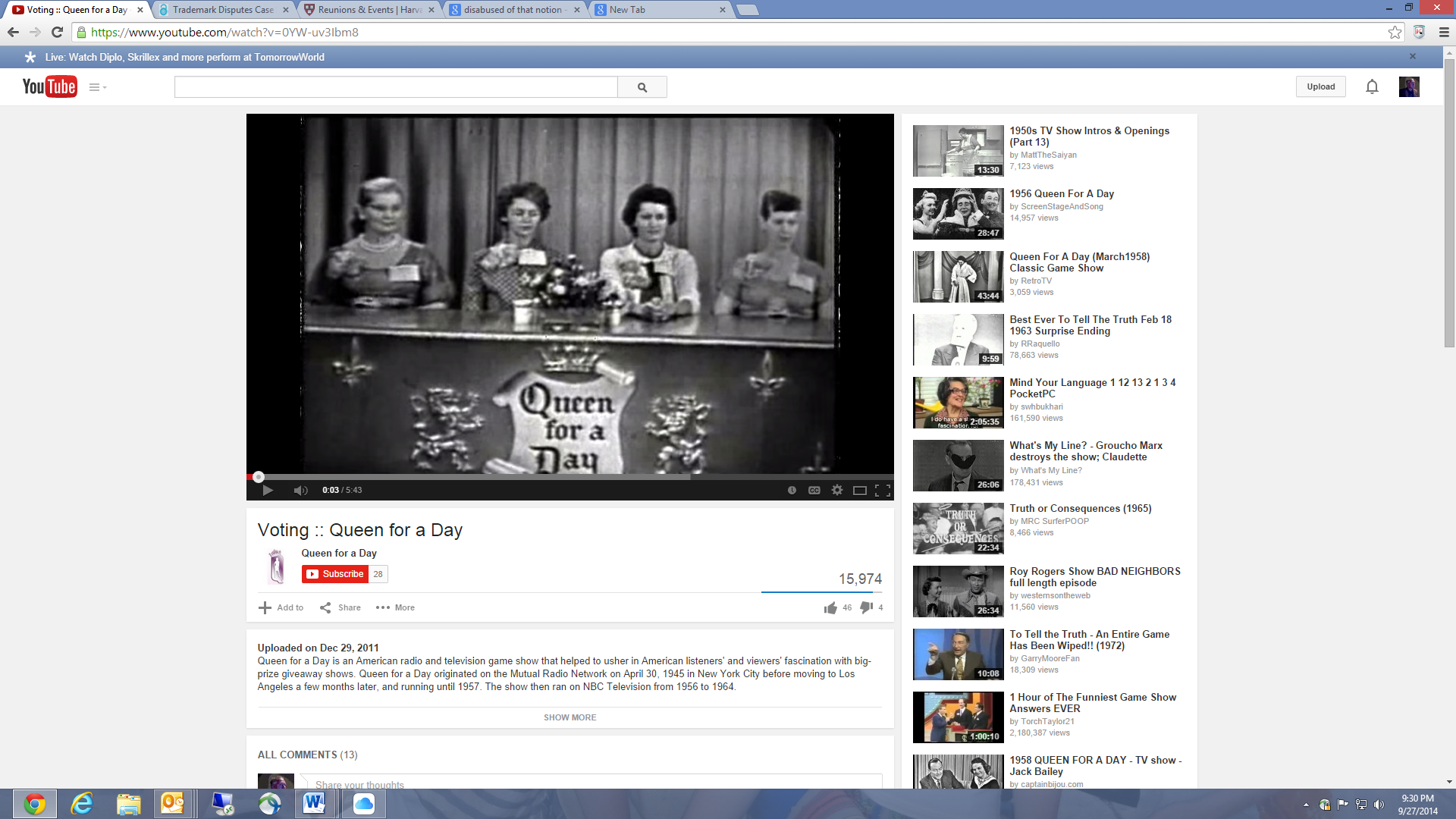
The climactic event of the reunion was a series of presentations rather misleadingly dubbed “The Eureka Moment!”.  This was not the kind of Eureka moment experienced by Archimedes in the bathtub.  Instead, members of this distinguished company vied with one another to present the most distressing, depressing, and often intimate episode of their lives. The format was eerily reminiscent of the old “Queen For a Day” television show, where contestants competed to see whose life was the most pathetic, with the winner receiving a slew of valuable prizes.Queen for a Day 1.jpg

What led these successful people to participate in this strange event?  Quite possibly, the same compulsions that made them successful in the first place.Queen for a Day 1 Continue reading

6 Comments

Filed under Culture

THE REDSKINS TRADEMARKS: CANCELLATION AND CONSEQUENCES

The cancellation of the six REDSKINS trademark registrations is not so much a victory for American Indians, as it is a defeat for commercial speech, which means a defeat for the First Amendment.

According to the Trademark Trial and Appeal Board (“TTAB”), 30% of American Indians consider REDSKINS a disparaging and offensive term.  Even assuming that is so — and the flimsy record in the case does not inspire confidence — the decision should alarm Americans of every category.  For the logic of the TTAB’s ruling gives any minority faction — regardless of the merit of their position — the power to deprive others of the important governmental benefit of trademark registration, which is a form of constitutionally protected commercial speech.

redskins mark

Many commentators have viewed the case as a contest over respect for Native Americans.  But the TTAB ruling transcends the trademarks in question.  One does not have to agree that a word with obvious racial overtones like “redskins” is an appropriate choice for a football team, to appreciate the chilling effects of the ruling.

The root of the danger does not lie with the 2-1 majority decision to cancel.  It lies with the law they applied.    Continue reading

8 Comments

Filed under Culture, Law

A TALE OF TWO ESSAYS

It’s May, the season of college graduation ceremonies, when the college careers of seniors terminate at what are paradoxically called “commencement” exercises.

A great deal of attention will be paid to those invited to speak at these ceremonies, even though most of what they have to say will be rich in platitudes and eminently forgettable.  In fact, this year’s crop of commencement speakers will probably be better remembered for those who did not speak than for those who did.  Ayan Ali Hirsi, Christine Lagarde, Condoleesa Rice, Charles Murray, and Robert Birgeneau are among a growing list of interesting people who have been “disinvited,” or otherwise pressured to stay away, in a misguided campaign to shield undergraduates from viewpoints that might make them “uncomfortable.”graduates1

But for those interested in the state of education at America’s colleges, it may be less important to listen to what the elders have to say to the students than to what the students themselves have to say.

Two Ivy League student essays are worth examining, if only to note their starkly contrasting visions. One is an optimistic picture of a world in which success is possible to all, provided only that they are equipped with the right values.  The other is a grim picture where victimhood is inescapable, no matter how many blessings one receives.  It may be coincidence, but the fact that the first is written by a freshman, and the second by a senior, suggests a troubling explanation: the modern university may be deadening the spirit of its young charges. Continue reading

1 Comment

Filed under Culture

THE PUBLIC RIGHT TO KNOW … TOO MUCH

The termination of Brendan Eich – a big story earlier this month — raised important First Amendment issues concerning the boundary line between the right of individuals to engage in private political activity and the public interest in campaign finance disclosure.  There is a tension between the two.  The Eich affair tells us it’s time to take a fresh look at balancing them.


EichBrendan Eich you will recall (the news cycle moves so swiftly these days) is the geeky pioneer and inventor of Javascript.  He was forced to resign after only ten days as CEO of Mozilla.  His sin was donating $1,000 six years earlier to support California’s Prop 8, a ballot initiative which deemed marriage as an institution between a man and a woman.  In 2008, when Eich made his donation, that idea commanded the assent of every Presidential candidate, including Barak Obama and Hillary Clinton.  Prop 8 was approved with 52% of the vote.

Prop 8 was subsequently invalidated by the courts, and the passage of time has changed popular attitudes. Today, same-sex marriage commands majority support in every region of the country, and in every age group.

But Eich’s 2008 contribution – like that of all contributors, pro and con, to the Prop 8 contest –remains a matter of public record.  And publicity has its consequences.  In Eich’s case, it was a career-ender.

Commentators may have differed on their attitudes toward his termination, but a consensus quickly emerged that this was a private matter between him and his employer, and, as such, beyond the reach of the First Amendment.

“At the risk of sounding pedantic,” wrote a commentator for Slate, sounding pedantic,

…[T]the First Amendment applies exclusively to state actors, like Congress or state legislatures, so a private corporation like Mozilla simply cannot infringe upon an employee’s free speech rights, even if it wanted to. There is no wiggle room around this point. It is a basic constitutional fact.

A commentator for National Review Online agreed that “this sordid and alarming little affair does not in any way implicate the First Amendment.”  Andrew Sullivan, redoubtable champion of same-sex marriage but also one of the first to criticize Mozilla for its intolerance, conceded that Eich “wasn’t a victim of government censorship or intimidation….  He still has his full First Amendment rights.”

Well, no.  Eich doesn’t have his full First Amendment rights.  He never did.

Continue reading

3 Comments

Filed under Culture, Law

LOVE AMONG THE HIGHBROW, AND THE LOW

What is the source of wisdom?

We are not born understanding thermodynamics or quantum mechanics, nor are we skilled innately to play Rachmaninoff’s Piano Concerto No. 3 or to perform spinal surgery.  The knowledge required for such undertakings comes from long years committed to education and training.

But what are the intellectual requirements for offering insights into the deepest human mysteries?  Do “highbrow” and “lowbrow” matter when the subject is the meaning of love?

I would argue not, and I would offer into evidence the testimony of two witnesses to support my case.

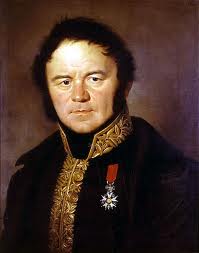
Marie-Henri Beyle, widely known by his pen name Stendhal, was a 19th-century French intellectual, polemicist, and novelist.  He authored De L’Amour (On Love), the classic work on the nature of love.

Image Continue reading

4 Comments

Filed under Culture

WHERE ARE THE MANDELA’S?

Next week, three U.S. Presidents and 26 members of Congress will join over 60 world leaders, to attend the funeral of Nelson Mandela in Johannesburg.  This is a remarkable outpouring of global respect for a man who led a small country (South Africa’s population was 35 million when Mandela was elected to lead it) for a short time (Mandela served one four-year term as President, then retired).  It demonstrates the power of the moral life to inspire, a life which, in Mandela’s case, evidenced determination in the face of oppression, dignity in confinement, and forgiveness and reconciliation in victory.

Since his death, many commentators have cited Mandela as an exemplar of Thomas Carlyle’s theory of the “Great Man.”  Carlyle, a nineteenth century Scottish writer, maintained that human progress is powered by the actions of a few heroic figures.  “The history of the world is but the biography of great men,” he wrote.  Carlyle’s heroic view has always been controversial. His contemporary, Herbert Spencer, deemed it childish and primitive.  Spencer saw history as the product of larger, impersonal social and economic forces.  These forces made the so-called Great Men more than the Great Men made history.  “Before he can remake his society,” Spencer wrote of Carlyle’s hero, “his society must make him.”MANDELA

The social system into which Mandela was born was a retrograde and odious system of racial separation.  He spent most of his life fighting it, and when he had won, he forgave his oppressors and tried to work with them in building a new social system.  It is hard to find precedents for the magnanimous course he followed after release from his 27-year imprisonment in 1990.  Perhaps Abraham Lincoln, with his reconciliation plans for the defeated Confederacy, would have furnished an example, had he lived.


Continue reading

1 Comment

Filed under Culture

ZOMBIES: ARE THEY GOOD FOR THE JEWS?

Readers of a certain vintage raised in Jewish homes will recognize the question posed by the title as the ultimate arbiter on issues of the day.  Is Sammy Davis Jr. good for the Jews?  Absolutely, I’m kvelling.  Is Eisenhower good for the Jews?  Not so much.  Even today, the expression survives.  The Wall Street Journal recently published a column assuring its readers that the new Pope Francis would be “good for the Jews.”

Now Brad Pitt’s summer movie spectacular, World War Z, has the world wondering: are zombies good for the Jews?

"Next year in Jerusalem!"  zombies pray.

“Next year in Jerusalem!” zombies pray.

Continue reading

5 Comments

Filed under Culture